
Rishi Sunak
Conservative Party
Image credit: Rishi Sunak, Simon Walker, 24 November 2022. Prime Minister’s Office/No 10 Downing Street. Open Government Licence v3.0
Rishi Sunak
I stand here before you ready to lead our country into the future. To put your needs above politics. To reach out and build a government that represents the very best traditions of my party.
Conservative Party
October 2022 - July 2024
Oct 2022 - 5 Jul 2024

Image credit: Rishi Sunak, Simon Walker, 24 November 2022. Prime Minister’s Office/No 10 Downing Street. Open Government Licence v3.0
Key Facts
Tenure dates
25 Oct 2022 - 5 Jul 2024
Length of tenure
1 year, 255 days
Party
Conservative Party
Spouse
Akshata Murty
Born
12 May 1980
Birth place
Southampton, Hampshire, England
About Rishi Sunak
Rishi Sunak might well have been the first Asian, first Hindu, and the first millennial Prime Minister, but his rise to power resembled that of an 18th Century premier, more like Pitt than Blair. He did not win a general election and was defeated in a party leadership contest. Instead, Sunak became Prime Minister through a combination of ministerial competence, strong connections, bravery, party support, and luck.
Sunak was born in Southampton in May 1980, to Indian-origin Hindu parents, who were both born in Africa. He was educated at Stroud School and then the elite Winchester College, before graduating with a first in Philosophy, Politics, and Economics from Lincoln College, Oxford. Afterwards, he earned a Master of Business Administration from Stanford University as a Fulbright Scholar, where he met his future wife, Akshata Murty. After that, during the early 2000s, Sunak worked at an investment bank, followed by stints at two high profile hedge funds, followed by a directorship at another hedge fund from 2013.
Given his lucrative and successful career, it might be thought somewhat surprising that Sunak decided to suddenly change tack and enter the gritty world of politics. But, in 2014, he was selected as the Conservative candidate for Richmond (Yorks), a safe Tory seat, previously held by Foreign Secretary William Hague. That year, he burnished his credentials by co-authoring a Policy Exchange report called A Portrait of Modern Britain.
Sunak won the seat in the 2015 election, which turned out to be a surprising win for Prime Minister David Cameron and the Conservatives. The following year, Sunak backed Leave in the European Union membership referendum, going against Downing Street’s wishes. With Cameron’s resignation from the premiership, Sunak supported first Michael Gove and then Theresa May, who ultimately prevailed.
In 2018, as May’s government staggered under the blows of Brexit, Sunak was appointed as Local Government minister. When May’s premiership finally reached its sorry end in 2019, Sunak supported Boris Johnson.
It was Johnson who made Sunak Chief Secretary for the Treasury in 2019. Then, in February 2020, Chancellor Sajid Javid resigned over a squabble related to Downing Street advisers. In his place, Sunak was appointed as Chancellor. His rise had been meteoric, from a new MP to the second highest office in the land within just five years. After the long Brexit debate shaped by people who had been national figures for years, if not decades, including Cameron, Johnson, and May, Sunak seemed like a breath of fresh air.
COVID-19 struck with full force in March 2020. The government ordered emergency measures, including social distancing and, eventually, a strict lockdown. Faced with economic collapse, Sunak introduced a £330 billion programme of unprecedented economic support for businesses, including a furlough scheme to pay employees, which ran until September 2021. Rishi Sunak started the year as a relatively unknown politician, but by June around 70% approved of his performance as Chancellor. The man the tabloids nicknamed ‘Dishy Rishi’ finished 2020 as the most popular politician in the country.
Sunak built a dedicated and tight knit team that appreciated his leadership style, repaying his loyalty with their own. Fiercely intelligent, he could be trusted with complex issues and would work late into the night, establishing a reputation for competence. Careful preparation ensured a solid parliamentary performance, though without Johnsonian flourish. He soon enjoyed considerable respect amongst Tory MPs.
Sunak’s nationwide popularity was destined to fall, but he remained as Chancellor over 2021-22, managing the aftermath of the COVID Crisis, and then the early fallout from the 2022 Russian invasion of Ukraine. In 2021, he hosted the G7 finance ministers’ conference in London.
While Sunak’s popularity had risen, Prime Minister Boris Johnson’s had fallen. He had been surrounded by scandals since 2020. Indeed, Sunak himself had been tarnished, being fined for breaching COVID regulations. But, while Sunak’s indiscretion could be framed as a one-off mistake, Johnson’s scandals piled up. In June 2022, Johnson survived a vote of no confidence, but 148 of his MPs voted against him.
On 5 July, just after 6pm, Health Secretary Sajid Javid resigned. Minutes later, Sunak announced his resignation too. Javid resigned because he thought Johnson lacked integrity. Sunak because Johnson was not prepared to make difficult decisions on the economy. Their joint act triggered the collapse of Johnson’s government.
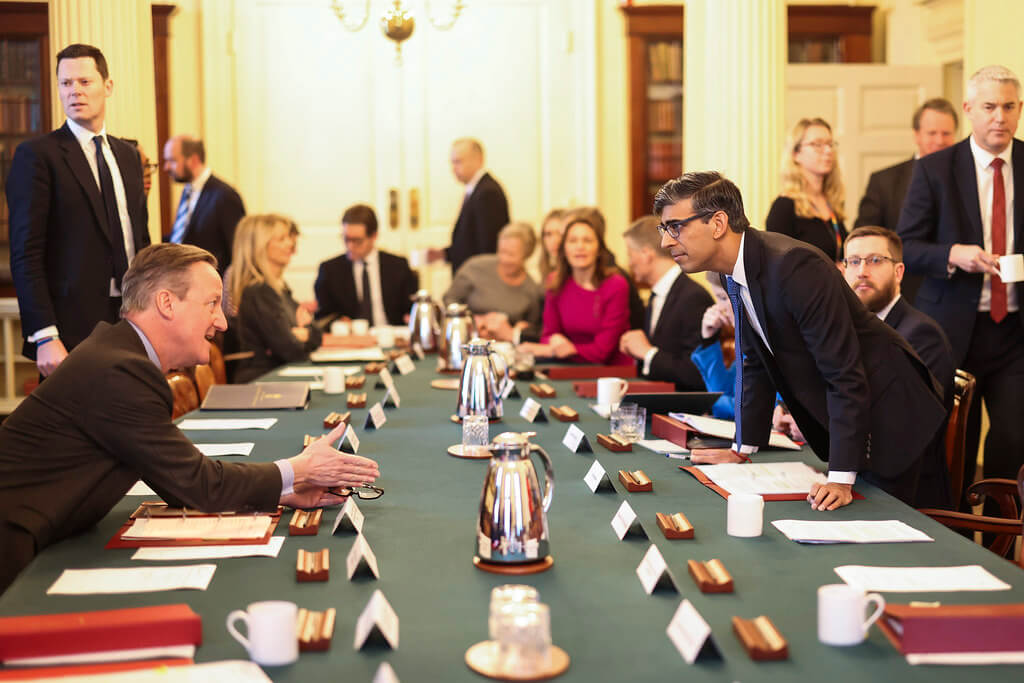
In the leadership election that followed, Sunak could not shake off the perception that he had ‘betrayed Boris’, who remained popular amongst the Conservative Party’s rank and file. Moreover, Sunak’s talk of responsible economic management paled beside Liz Truss’s promise of Thatcherite tax cuts. Though Sunak halved the gap that had been forecast by some opinion polls, Truss still won the leadership by a decisive margin and Sunak was cast out defeated to the backbenches, unlikely to return to government for the foreseeable future.
Once again, however, fate intervened. Truss’s premiership imploded. Sunak quickly amassed the 100 MPs required for the leadership ballot, and both Boris Johnson and Penny Mordaunt withdrew. On 25 October, Sunak became Prime Minister, the first British-Asian, first millennial, and, at 42, the youngest since Lord Liverpool.
Sunak’s premiership dealt with a difficult economy, the continuing war in Ukraine, and a new major conflict in the Middle East. Though he tried to reset the opinion polls, the country was largely sick of the Conservative Party after 12 years and wanted a change of government.
Sunak was defeated in the general election of July 2024. His premiership ended on 5 July, exactly two years after his resignation as Chancellor. He remained Conservative leader until November and until then took his place in Parliament as Leader of the Opposition. He was the first former Prime Minister to lead the Parliamentary opposition since John Major in 1997. At 44, he was the youngest former Prime Minister since William Pitt the Younger in 1801.
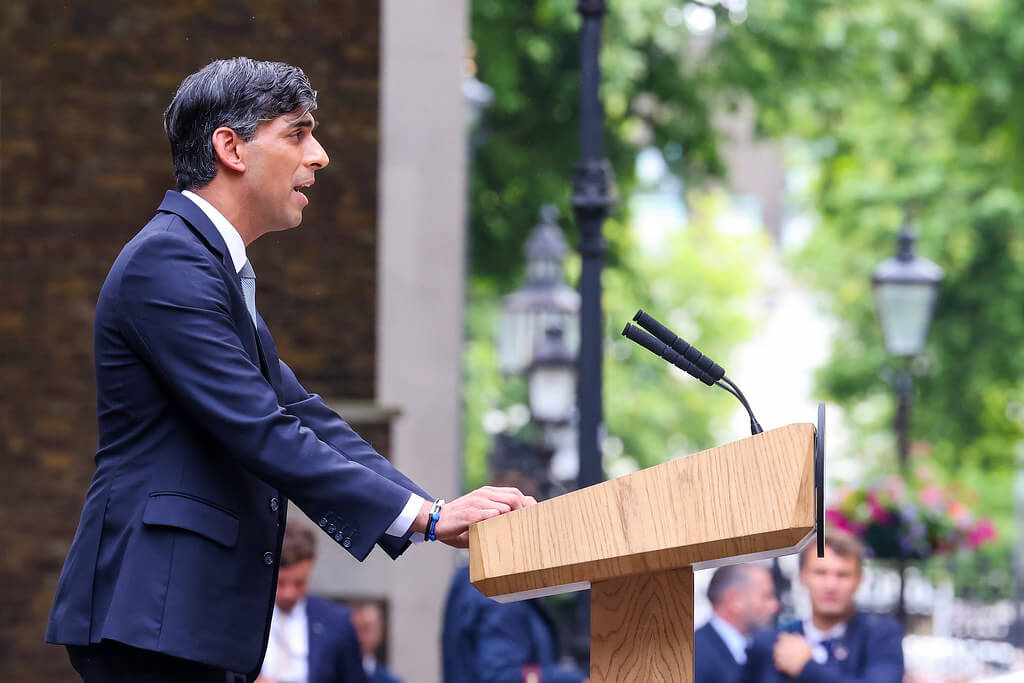
Many predicted that Sunak would quickly leave Parliament for a gentler climate. However, to his great credit, he remained as a backbench MP, and, by doing so, is the only one of the six former Prime Ministers of the 21st Century still in the House of Commons.
Premiership
Sunak became Prime Minister on 25 October 2022. He was the fifth Conservative Prime Minister since 2010, and the seventh of the 21st Century. In his speech outside Downing Street he set his priority as ‘the profound economic crisis’ and promised to earn the country’s trust.
A believer in traditional Tory economics, Sunak set to work stabilising the nation’s finances. The economic challenges were indeed profound, with high interest rates and inflation. Energy prices had rocketed due to the war in Ukraine and many predicted a grim recession. Additionally, international economic confidence in Britain had been heavily damaged by the Truss experiment and would have to be rebuilt. Sunak retained Jeremy Hunt as his Chancellor, seeing him as the proverbial ‘steady pair of hands’. The decisions contained in November’s budget were painful: tax rises coupled with spending cuts.
From the outset of Sunak’s premiership, the Conservative Party was deeply unpopular, and re-election in 2024 was a forlorn hope. The Party had been in power since 2010 and the public were tired of them after the experience of Johnson and Truss. On two occasions, at the beginning and towards the end of 2023, Sunak attempted to shift the polls with big relaunches. In October, he promised to break the “30-year political status quo” and signalled his intention by cancelling part of the HS2 railway. But, nothing worked and the Tories were 20 points below Labour at the beginning of 2024.
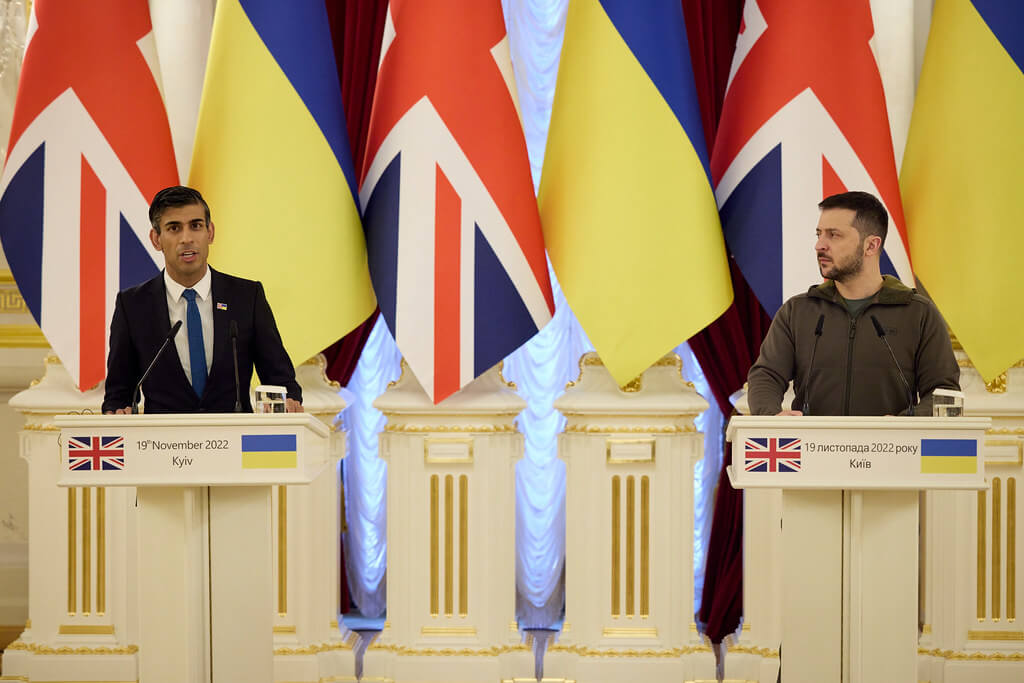
Foreign affairs would take a great deal of Sunak’s time. Sunak continued British support for Ukraine and made a visit to Kyiv to meet President Zelensky his first European trip in November 2022. He pledged a further large aid package in 2024 as well and urged Britain’s diplomatic allies to take an assertive approach to the Russian aggression.
In February 2023, Sunak agreed the Windsor Framework with the European Union. It delivered a new set of dual regulations to replace the original Northern Ireland Protocol. Goods staying in Northern Ireland faced minimal checks, whilst goods likely to move into the EU would be more tightly regulated. A ‘Stormont brake’ allowed the Northern Irish Assembly to object to EU goods rules being applied. The framework generally granted the UK greater freedom over VAT and subsidy rules. Sunak was able to convince a sceptical Tory party to back the plan in Parliament. The agreement was a considerable accomplishment and improved relations with the EU. It also helped to pave the way for the restoration of power sharing in Northern Ireland in February 2024.
On 7 October 2023, Hamas attacked Israel, leading to a major conflict in the Middle East. Israel fought off the attack and then launched a destructive counterattack on Gaza. Sunak pledged British support for Israel, though he was uneasy at the level of civilian loss in the subsequent conflict.
The Middle East Crisis escalated. In January 2024, Sunak ordered British forces to strike, alongside US forces, at Houthi targets in Yemen, which were trying to close the Red Sea to maritime traffic. In April, he ordered British forces to assist the Israeli military in defending the country from Iranian drone attack. The war also created bitter controversy in Britain, especially amongst the Muslim population, with major demonstrations in London, contributing greatly to escalating social tensions. Consequently, Sunak addressed the nation in March 2024, condemning ‘a shocking increase in extremist disruption and criminality.’
Immigration was another major issue. In 2019, Johnson had promised lower immigration. But, during his premiership, he had allowed net immigration to increase, and it reached over 750,000 a year. Further anger was created by the issue of illegal immigration via small boats crossing the English Channel. Sunak’s solution was an ambitious and controversial plan to relocate illegal immigrants in Rwanda, but the scheme was not running by the end of Sunak’s premiership and was ultimately a failure. As such, the issue contributed to the government’s plummeting popularity.
In November 2023, Home Secretary Suella Braverman sharply condemned the pro-Palestine protests and the policing around them in an article for The Times. Though she had shared the article with Number 10, their requested changes had not been included. Tensions between Sunak and Braverman had been rising for a while, with sharp disagreements over policy on immigration and trade, together with Sunak’s irritation at Braverman’s freewheeling style. He decided to replace her.
With Braverman’s dismissal, Sunak began a wider reshuffle of his government on 13 November 2023. To great surprise, former Prime Minister David Cameron arrived at Downing Street to be appointed Foreign Secretary. This was an enormous coup de theatre and had been kept completely secret. Cameron was not even in Parliament and was subsequently raised to the House of Lords. The appointment took some of the pressure off Sunak, because Cameron could take on considerable responsibility for foreign affairs and diplomacy. Cameron’s appointment helped to reinforce Sunak’s focus on professionalism and stability in uncertain times.
Perhaps Sunak’s greatest successes were in the field he knew best, economics. Sunak quickly demonstrated sound economic leadership, and within a few months, the markets had normalised after the Truss shock. He worked with the Bank of England to reduce borrowing costs. Inflation, which rose above 11% in October 2022, fell below 3% by the summer of 2024. A major trade agreement (the Comprehensive and Progressive Agreement for Trans-Pacific Partnership) was signed, which aligned Britain with Australia, Chile, Malaysia, Japan, Vietnam, and New Zealand. The predicted recession of late 2023 was shallow, and the economy returned to growth over 2024, with a 0.7% increase in GDP in the first quarter of that year.
Sunak announced a general election on the 22 May 2024, surprising his own MPs and his own government ministers, who had thought he intended to wait until the autumn. While it was a bold move, there was little that he could do to shift the polls. His performance in the debates was strong, especially on economic matters. But, he then made a major blunder by leaving the commemoration for the 80th anniversary of the D-Day landings early, creating a minor scandal.
Whatever Sunak’s missteps, it probably made little difference. The 2024 election saw the Tories assailed from all sides. Labour regained its northern seats, whilst the Lib Dems seized the South and Southwestern Shires. From the right, Nigel Farage’s energised Reform Party mounted an insurgent’s campaign, which delivered him four million votes (third to only Labour and the Tories) and five Parliamentary seats.
When the result came, it was indeed the thrashing so long predicted. Two hundred and fifty one Conservative seats were lost, and only 121 Tory MPs returned to Parliament, the worst result in the Party’s history. Sunak resigned immediately.
In his departure speech, he reflected on his premiership, saying he was proud of his achievements. He said that ‘One of the most remarkable things about Britain is just how unremarkable it is that two generations after my grandparents came here with little, I could become Prime Minister and that I could watch my two young daughters light Diwali candles on the steps in Downing Street. We must hold true to that idea of who we are that vision of kindness, decency, and tolerance that has always been the British way.’
Personal life
Sunak married Akshata Murty in 2009. They have two daughters.
Parliament
Sunak was MP for Richmond (Yorks) between 2015-24. In 2015, he won the seat with 51% of the vote, which increased to over 60% in the 2017 and 2019 elections. The seat became Richmond and Northallerton for the 2024 election, when Sunak won it again. At the time of writing, he remains MP.
Key Events
 Keir Starmer
Collections & Content
Andrew Bonar Law
Bonar Law was the shortest serving Prime Minister of the 20th Century, being in office for just 209 days. He was gravely ill when he t...
The Earl of Rosebery
Lord Rosebery was Gladstone’s successor and the most recent Prime Minister whose entire parliamentary career...
Arthur James Balfour
Arthur Balfour was Salisbury’s successor. He had a reputation as a good parliamentarian, a capable minister, and an excellent ta...
The Duke of Wellington
Wellington is a Prime Minister who is today largely remembered for achievements unrelated to his premiership. ...
The Duke of Grafton
The Duke of Grafton believed, according to Horace Walpole, that ‘the world should be postponed to a whore and a...
Benjamin Disraeli
Charming, brilliant, witty, visionary, colourful, and unconventional, Benjamin Disraeli (nicknamed ‘Dizzy’) was one of the greate...
Boris Johnson
Boris Johnson is one of the most charismatic and controversial politicians of the modern era. To supporters, he was an authentic voice wh...
The Earl Grey
Earl Grey was the great aristocratic reformer. His government passed the ‘Great Reform Act of 1832’, ending an entire e...


