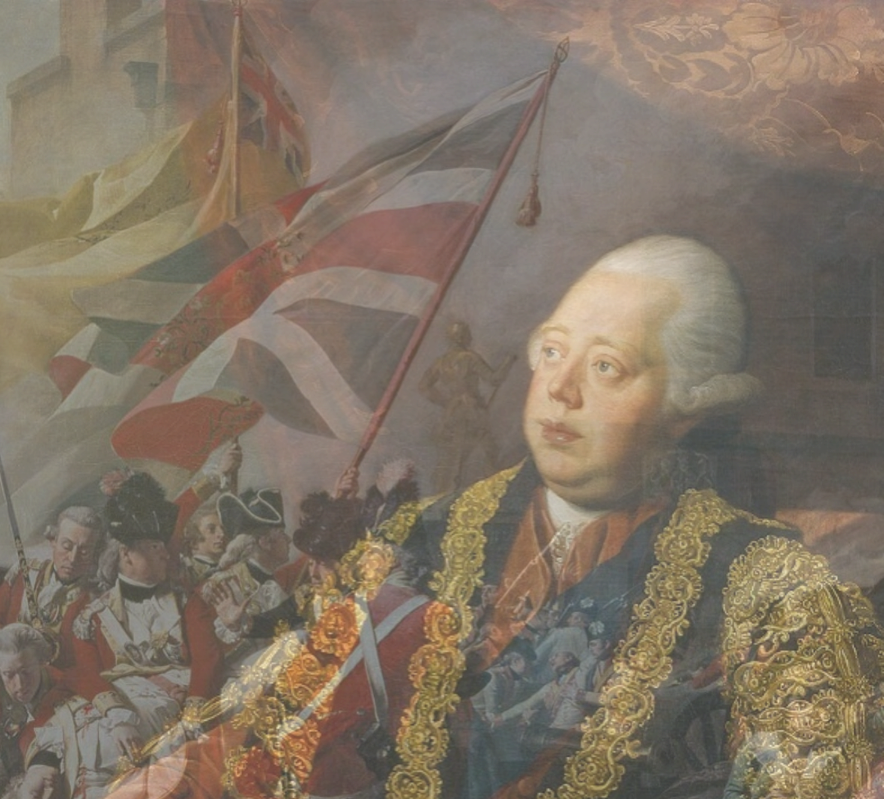
The man who lost America

Frederick North, better known by his courtesy title Lord North, was one of George III’s most able and effective Prime Ministers. He held office for over a decade. Yet today, he is remembered only as “The Man who Lost America”…

Contains elements from "The Death of Major Peirson, 6 January 1781" -  John Singleton Copley and "Frederick North, 2nd Earl of Guilford" - Nathaniel Dance-Holland, both images are Public domain, via Wikimedia Commons

Contains elements from "The Death of Major Peirson, 6 January 1781" -  John Singleton Copley and "Frederick North, 2nd Earl of Guilford" - Nathaniel Dance-Holland, both images are Public domain, via Wikimedia Commons

This year is the semiquincentennial (or 250th Anniversary) of the American Declaration of Independence. This two-part article by Jonathan Meakin looks at Lord North’s role in those momentous events.


London 1770

Over the 1770s, it would fall to Lord North to set policy towards the American colonies. American affairs had dominated British politics since the Seven Years’ War, when, during 1750s the British had fought the French for control of North America. Then, during the 1760s, the government attempt to tax North America created tremendous controversy.  Lord North became Prime Minister in 1770, determined to strike a more conciliatory course.

“New Horse Guards from St James’s Park” – Canaletto, Public domain, via Wikimedia Commons

Who was Lord North?

Frederick North was born in 1732 in Piccadilly into an aristocratic family. He was well connected; his father Francis North, Earl of Guilford was Lord of the Bedchamber to Frederick, Prince of Wales. Francis christened his son ‘Frederick’, in honour of the prince. Frederick grew up as a close friend of the prince’s son, George.

Educated at Eton College and Trinity College, Oxford, he did the Grand Tour of Europe in his youth, including nine months living in Leipzig. In 1754, aged 22, he was elected unopposed as the MP for Banbury. From 1752, he used the courtesy title ‘Lord North’, though he would sit in the House of Commons as an MP for almost his entire political career (he was raised to the peerage when he inherited his father’s title as Earl of Guilford in 1790).

North was appointed a Lord of the Treasury in the Newcastle-Pitt government in 1759. During the invasion scare of the Seven Years’ War, he briefly served as a part-time officer in the North Somerset militia over 1759-61, though that was the limit of his military experience.  When the invasion threat receded, he focused on his political career. He would depart from the government with the fall of Grenville, before returning to office as a Treasury minister under Lord Chatham in 1766.

In 1767, North became Chancellor, achieving success in the role. One observer wrote of North’s 1769 budget speech that ‘I verily think I have never known any of his predecessors acquit themselves so much to the satisfaction of the House.’[1] During this period, North became gradually associated with the ‘Tory’ faction in Parliament.

Impressed by his performance as Chancellor, in January 1770 North’s childhood friend, now King George III, asked him to head the government as Prime Minister at the age of just 37. George was sick of ministerial instability; North was the seventh Prime Minister since 1760, and he wanted somebody reliable and enduring.

The decision seemed to be swiftly justified; North was a good manager of ministers. He quickly stared down a Spanish attempt to retake the Falklands Islands in 1770. Over the years that followed, North focused on administrative reform and was able to reduce the nation’s debts by £10 million by 1775. The turmoil of the 1760s appeared to have settled into a form of ministerial tranquillity.

As head of the ministry, North relied heavily on the ‘King’s Friends’ in Parliament, a group broadly aligned with the King and his interests. Just as it had been in Walpole’s day, Georgian politics was shaped by patronage, appointments, and personal influence, rather than modern party discipline. North excelled at the subtle art of Parliamentary management, possessing all the social skills of persuasion, firmness, and flattery that a Georgian Prime Minister required to keep a majority in place.

Affable, polite, optimistic, witty, and intelligent, North was well liked by his fellow MPs. One friend later wrote that ‘he had travelled over a considerable part of Europe, and he knew the Continent well; he spoke French with facility, and was equally versed in the great writings of antiquity’.[2] Indeed, the great historian Edward Gibbon would dedicate a volume of his monumental Decline and Fall of the Roman Empire to North. Gibbon thought him ‘one of the best companions in the Kingdom’.[3] One political ally wrote that ‘he possessed a classic mind, full of information, and always enlivened by wit, as well as sweetened by good humour…It was impossible to experience dullness in his society’.[4] He worked desperately hard, with one writing to the King to say ‘His labours are immense and such as few constitutions could bear.’[5]

Parliamentary debate was where North really shone. While never capable of the sort of volcanic performances of contemporaries like William Pitt the Elder, or the direct and charismatic Charles James Fox, North was considered a ‘master of debate’. One who saw him in the Commons called him ‘powerful, able, and fluent …sometimes repelling the charges made against him with solid argument, but still more frequently eluding or blunting the weapons of his antagonists by the force of wit and humour.’ He ‘possessed a vast facility and command of language.’[6] One writer recorded Fox fuming after North had bested him once again: “The Prime Minister is satisfied if he can only raise a laugh.”[7]  Even in the darkest days of the American War, one reflected, ‘the noble Lord is ready with his joke’.[8] A sense of humour can go a long way.

His political opponents, of whom there were many, accused him of vacillation. He shied away from the sort of confrontation that political leaders must exercise, however uncomfortable. A friend wrote that ‘He naturally loved to postpone, though when it became necessary to resolve, he could abide firmly by his determination’.[9] It could take North weeks to respond to letters, and he would often put off decisions, as would prove during the American crisis.[10] Above all, North’s strengths were in parliamentary business and financial administration. He was not a visionary and was much more at home in the Treasury with tables of accounts than he was poring over maps and formulating global strategy.

Had North lived in a peaceful time, he might have been a successful, and probably completely forgotten 18th Century Prime Minister. As so often in Prime Ministerial history, when in power, he was confronted by a crisis that demanded far more than his abilities could handle.

Frederick North, 2nd Earl of Guilford
“Frederick North, 2nd Earl of Guilford KG, FSA (1732-1792)” – Joshua Reynolds, Public domain, via Wikimedia Commons

A cartoon of ‘The Colosus [sic] of the North; or Striding Boreas’
A cartoon ‘The Colosus [sic] of the North; or Striding Boreas’ is a 1774 cartoon showing Lord North stood upon blocks labelled ‘Tyranny’ and ‘Venality’. Britannia holds a sign stating that “Those that should have been my preservers have been my destroyers”. While this is very much an anti-North cartoon, it shows his dominating influence on Parliamentary affairs – Public domain: https://www.loc.gov/resource/cph.3a35354
[1] ‘North, Frederick, Lord North’, The History of Parliament.
[2] Wraxall, Memoirs, Volume I, p. 371.
[3] ‘North, Frederick, Lord North’, The History of Parliament.
[4] Wraxall, Memoirs, Volume I, p. 371.
[5] ‘North, Frederick, Lord North’, The History of Parliament.
[6] Wraxall, Memoirs, Volume I, pp. 364-5.
[7] Wraxall, Memoirs, Volume I, p. 365.
[8] Wraxall, Memoirs, Volume I, p. 365.
[9] Wraxall, Memoirs, Volume I, p. 371.
[10] ‘North, Frederick, Lord North’, The History of Parliament.

The Seven Years’ war

The Seven Years’ War of 1756-1763 had been the greatest military triumph in British history. The war had been fought all over the world, including in Europe and India, but North America was where the conflict began, and was the most intense theatre of combat for the British forces.

After a series of initial setbacks, a new government led by the Duke of Newcastle as Prime Minister and William Pitt the Elder as Secretary of State had energised Britain’s war effort. Vast sums of money were obtained through loans, and used to raise forces, particularly local colonial forces in North America. A great deal of money was also spent in winning over the Native American tribes who had, previously, supported the French. By 1759, a British army of over 40,000 men was in North America, divided roughly equally between British regulars and locally raised American raised forces, amongst the latter was a young Virginian officer named George Washington.

1759 proved to be the Year of Victories as French power crumbled under relentless British attack. French fortresses in America were seized and the French fleet was defeated at Quiberon Bay. Above all, the French North American capital of Quebec was captured by redcoats led by General James Wolfe in a daring attack, and at the cost of his own life. Both colonial American forces and Native American tribes had played a key role in many of these victories.

When peace came, all of the French claims to North America east of the Mississippi, and in Canada, were given to the British.[11] Suddenly, Britain was a great power, with a huge Empire in North America, colonies in the Caribbean, and territories in India as well.

Benjamin West’s iconic painting The Death of General Wolfe, showed General James Wolfe dying as a martyr of the British Empire at the Battle of Quebec in September 1759. His dramatic victory seized the capital of New France and turned the tide in North America. The war effort in New France never recovered from the defeat, and the remainder of the colony was entirely conquered the following year.
“The Death of General Wolfe” – Benjamin West, Public domain, via Wikimedia Commons. Benjamin West’s iconic painting The Death of General Wolfe, showed General James Wolfe dying as a martyr of the British Empire at the Battle of Quebec in September 1759. His dramatic victory seized the capital of New France and turned the tide in North America. The war effort in New France never recovered from the defeat, and the remainder of the colony was entirely conquered the following year.
The British domain in North America in 1775. On the East Coast are the Thirteen Colonies, which were populated by some 2.5 million people, with thriving economies and bustling cities. The Proclamation Line of 1763 marked the boundary of what had been hitherto French territory and roughly followed the Appalachian mountains. The land beyond was officially designated for the Native Americans by the Crown, but many of the colonists in the Thirteen Colonies believed that they ought to be allowed to take the land for themselves. This map shows modern US state boundaries in white, only the state boundaries of the red coloured Thirteen Colonies are accurate for the 1775.
“Map of territorial growth 1775” – Cg-realms, Public domain, via Wikimedia Commons. The British domain in North America in 1775. On the East Coast are the Thirteen Colonies, which were populated by some 2.5 million people, with thriving economies and bustling cities. The Proclamation Line of 1763 marked the boundary of what had been hitherto French territory and roughly followed the Appalachian mountains. The land beyond was officially designated for the Native Americans by the Crown, but many of the colonists in the Thirteen Colonies believed that they ought to be allowed to take the land for themselves. This map shows modern US state boundaries in white, only the state boundaries of the red coloured Thirteen Colonies are accurate for the 1775.
  • [11] Spain, already a power in South America, received sparsely-populated territory West of the Mississippi that had formerly been claimed by France.

Further reading

The Royal Proclamation of 1763

The Royal Proclamation of 1763 was an early cause of friction between the colonists and the British. This limited the colonies to their existing territorial claims, preserving the lands beyond the Appalachians for the Native tribes, and preventing further settlements.

The American Colonies

By 1775, there were thirteen major mainland colonies[13] in North America from New Hampshire in the north to Georgia in the South, with a population of around two and a half million settlers, of whom 500,000 were enslaved Africans largely living in the Southern colonies.

The first successful English settlement in North America had been formed at Jamestown in Virginia in 1607. From this, the colonies had expanded westwards towards the Appalachians, with the population doubling roughly every twenty years.

By the mid 18th century, the colonies were thriving. Prosperous rural economies fed the growth of major cities, including Boston, New York, Philadelphia, and Charleston. Though, the societies differed starkly depending on geography. In the North, the economies were more egalitarian, with slavery playing a much smaller role and emerging anti-slavery movements.

By contrast, in the South, slavery was the bastion of the colonial economy, with many plantations owned by an aristocratic elite.

The colonies had a strong tradition of self-government. They were far from England, and decisions made there would take weeks to arrive. Consequently, the colonies had elected assemblies, while local matters were often settled with well attended town hall meetings. Many communities were deeply isolated and they relied upon local defence militia as frontier violence between settlers and Native Americans was very common. All of this led to a culture of self-reliance and self-government that was increasingly distinct from British politics.

Despite the distance, most of the population in the Thirteen Colonies saw themselves as British. They had celebrated the victory in the Seven Years’ War, and many colonists had fought alongside the British army. They believed that they possessed the full rights of Englishmen. Above all, they believed that they should not be taxed without representation.

  • [13] North of them as the Province of Quebec, which was largely populated by French speaking inhabitants, and then the yet even sparser populated Nova Scotia and Newfoundland. Ultimately, these areas would remain loyal to Crown, although for the Quebecois it was more a matter of passive support.

An escalating crisis

Lord North did not create the American crisis. It had already been an issue in British politics since the end of the Seven Years’ War.

Victory was costly. British national debt rose from £75 million in 1755 to £133 million in 1763, meaning up to £5 million, and £13,698 a day, in interest payments per year alone. Annual revenue was only about £8 million.[14]

Who was going to pay the debt that war had brought?

Britain was already heavily taxed. From the perspective of the British government, the war had been fought for the American Colonies. It evicted the French from the continent and simultaneously defeated their native allies. Moreover, some Crown forces were obliged to remain in North America due to Pontiac’s Native rebellion of the 1760s.[15] Surely the Colonies should show their gratitude to Britain and pay taxes, like everybody else?

In 1766-67, Chancellor Charles Townshend asked Parliament to introduce a series of taxes to the North American colonies. These raised duties on glass, lead, paints, paper, and tea. Other laws required the colonies to pay for and provide housing for British soldiers, otherwise known as ‘quartering’.

But, far from being accepted with polite obedience, the Townshend Acts created outrage in America. They were, opponents argued, ‘Taxation Without Representation’ and went against the rights of the colonists as Englishmen.[16] The colonists boycotted merchants who obeyed the laws, purchasing from smugglers instead.

In response, Parliament passed further laws, cracking down on smuggling and punishing those not complying with the regulations. New Admiralty courts were created, without juries, to try offenders.

There were widespread protests and, for the first time, a distinct sense of an American colonial identity emerged, with interests divergent from those of Britain.

‘HERE then, my dear countrymen, ROUSE yourselves, and behold the ruin hanging over your heads. If you ONCE admit that Great Britain may lay duties upon her exportations to us, for the purpose of levying money on us only, she then will have nothing to do but to lay those duties on the articles which she prohibits us to manufacture — and the tragedy of American liberty is finished.’ – John Dickinson, 1767[17]

In March 1770, the new Prime Minister Lord North introduced a bill partially repealing the Townshend Acts. However, he retained the duty on tea, as a demonstration of Parliament’s sovereign authority. This would be restated in the Tea Act of 1773.

[14] O’Shaughnessy, The Men Who Lost America, p. 50
[15] O’Shaughnessy, The Men Who Lost America, p. 50
[16] Boston Gazette, and Country Journal, 20 December 1773, Massachusetts Historical Society.
[17] ‘Colonists Respond to the Townshend Acts, 1767-1770, America in Class.

The King

George III succeeded to the throne in 1760, upon the death of his grandfather George II. Unlike his grandfather and great-grandfather, George I, who were sometimes accused of loving Hanover more than Britain, George III was unambiguously patriotic, saying in his accession speech “Born and educated in this country, I glory in the name of Britain.” He was just 22 when he became king.

Whereas his predecessors had been willing to govern from afar, leaving the day to day business of government in the hands of capable men like Robert Walpole, Henry Pelham, and the Duke of Newcastle, George III wished to do things differently. He would play an active role in politics, appointing and dismissing ministers, closely following developments in Parliament, and influencing government policies. This was an era when government was driven by an interplay between the Prime Minister and Cabinet, Parliament, and the King, with all playing a role in the formation and delivery of policy.

In Lord North, King George III believed that he had found ‘a man he could do business with’. Throughout the American Crisis, George would be a very important influence. He was unyielding in the face of the American colonists and strongly believed that he had to take a steadfast stance in protecting the sovereignty of Parliament. Unlike North, who was uncomfortable as the bloodshed escalated and hoped for some form of conciliation until very late, George III was determined that the war would be fought to a victorious conclusion.

King George III, in coronation robes, United Kingdom, portrait painting by Allan Ramsay, circa 1765.
King George III, in coronation robes, United Kingdom, portrait painting by Allan Ramsay, circa 1765. Allan Ramsay, Public domain, via Wikimedia Commons

The Unknown Knowns

Throughout the American Crisis, Lord North and his Cabinet, along with the rest of the political establishment, were bedevilled by several structural difficulties.

The Tyranny of Distance: Any decision needed four weeks or more to arrive in America, crossing thousands of miles of ocean by sailing ship. The return crossing could take six more weeks, especially in inclement weather. Consequently, British policy was often reactive, debates took place on news that was many weeks old. Decisions and debates reacted to events of months before. The troubles in America could sometimes seem a remote, and even rather abstract, problem.

The vastness of America: Very few British politicians had ever travelled to America. As a result, it was impossible for them to understand the reality of life and government in such a distant and vast territory. American colonies were quite unlike Ireland or Scotland, where rebellion could be isolated and efficiently destroyed by military force. By contrast, Virginia or New York alone were gigantic territories and were difficult to overawe with a show of force.

Unfamiliarity with America: British ministers did not understand American colonial culture, which was increasingly diverging from the mother-country. Americans were less deferential to aristocracy. Colonists were used to a level of autonomy and self-reliance. Particularly in the rural and frontier areas where they had their own arms and own militias. Moreover, by the 1700s, many colonial assemblies and institutions of local government had existed for decades, with very high levels of local participation. This was reinforced by a fairly literate society with a thriving trade in newspapers, books, and political pamphlets.

Continental identity: Ministers often assumed that the colonies were separate and unlikely to achieve any sort of unity or shared identity. This was not entirely unfair; the interests of the rigid slave owning Southern colonies like South Carolina and Virginia often diverged from the more egalitarian instincts of New England’s leaders. The colonies also infringed on each other’s land claims (which many saw as stretching westwards all across the continent). However, in response to Parliament’s policies, the colonies would find unity in opposition.

The Loyalist illusion: One of the key assumptions of Lord North’s ministers throughout the crisis was that the agitators were loud but not popular, and there was a large body of loyalists, simply waiting to reassert themselves once the radicals and hooligans were suitably dissuaded by a show of force. Once again, this was not entirely incorrect; there were many loyalists in North America, perhaps up to a fifth of the population, and in some areas they were dominant. But the view that there was a vast untapped reservoir of loyalists greatly overstated their influence and underestimated the deep and growing popularity of colonial opposition to Parliament’s measures.

It is important to recognise, however, that despite these difficulties, Britain’s political leaders were not fools. They believed that they were pursuing a course of high principle, namely the sovereignty of Parliament to rule the British Empire and to levy taxes. They also believed that they had the political, economic, and military instruments required to achieve victory, and to compel submission from the Americans. After all, Britain had won the Seven Years’ War against the mighty empires of France and Spain. Was the world’s most powerful Empire really going to back down in the face of a bunch of colonial rabble-rousers?


The Boston Tea Party

‘It is much to be wished that the Americans will convince Lord North, that they are not YET READY to have the yoke of slavery riveted about their necks, and send back the tea to whence it came.’ Boston Gazette, 11 October 1773.[18]

On 16 December 1773, the Sons of Liberty, a protest group in Boston, the capital of the British colony of Massachusetts, boarded the Dartmouth, an East India Company ship. They took the chests of tea from the hold, broke them open, and threw them into the harbour. Destroying the tea made clear that this was a political protest and not simply theft.

Their protest was against the Tea Act of May 1773, which mandated a small duty on tea sold in the American colonies. While small, the duty was symbolic, deliberately affirming the right of Parliament to levy taxes in the American colonies. This, the Sons of Liberty argued, was ‘Taxation Without Representation’ and violated their ‘rights as Englishmen’.

‘That it is the Opinion of this Town, that the British Parliament have no constitutional Authority to tax these Colonies without their own Consent, and that therefore, the present Duty laid upon Teas imported here from Great Britain, for the Purpose of a Revenue, is a Tax, illegally laid upon and extorted from us.’ Boston Gazette, 20 December 1773[19]

The protestors calculated that their protest would be heard in London, and that it would upset Lord North, his Cabinet, and Parliament.

Disguised as Native Americans, the Bostonian ‘Sons of Liberty’ throw the East India Company’s tea into the harbour. Cornischong at lb.wikipedia, Public domain, via Wikimedia Commons.

[18] Boston Gazette, and Country Journal, 11 October 1773, Massachusetts Historical Society.
[19] Boston Gazette, and Country Journal, 20 December 1773, Massachusetts Historical Society.

Crisis, 1774-76

Decision: The coercive acts

The message received from Boston was understood in Westminster.

The Colonial protest for representation fell on deaf ears. For Lord North, his Cabinet, most MPs and Peers, and the King, Parliament was sovereign and the ultimate authority. Only Parliament could levy taxes and pass laws.

The doctrine of ‘Virtual Representation’ was deeply accepted amongst the British establishment. This was that Parliament represented the interests of the entire British realm, including the entire Empire, regardless of whether people directly voted for it. After all, most people in Britain could not vote, but they were still required to follow Parliament’s law.

Moreover, colonial representation would excessively complicate British politics; turning Parliament into an transatlantic legislature. Nor could decisions be left in the hands of colonial assemblies, who would not be inclined to pay Imperial taxes. Britain was not going to give political autonomy to Virginia or Massachusetts anymore than it was to Ireland. Parliament, by contrast, represented the interests of the whole empire, not just those of the colonies.

North made the argument that after so flagrant a rebellion in Boston, Parliament had to make a stand:

‘The Americans have tarred and feathered your subjects, plundered your merchants, burnt your ships, denied all obedience to your laws and authority; yet so clement, and so long forbearing has our conduct been, that it is incumbent on us now to take a different course. Whatever may be the consequence, we must risk something; if we do not, all is over.’ Lord North, 22 April 1774.[20]

Believing concession impossible, Lord North believed it was time for a show of force. In early 1774, he drew up four punitive laws, with the aim of punishing Boston and Massachusetts as a whole for the Boston Tea Party.  These would become known as the Coercive Acts:

  • The Boston Port Act closed Boston Port, pending payment for the destroyed tea.
  • The Massachusetts Government Act repealed Massachusetts’ charter, and required all positions of colonial government to be appointed by London. Town meetings were to be limited to one per year, except in extraordinary circumstances.
  • The Administration of Justice Act allowed the royal governor to have colonists tried in Great Britain, rather than in Massachusetts, where they might face a friendly jury.
  • Finally, another Quartering Act was imposed. This allowed the Royal governor to house soldiers in unoccupied buildings, regardless of the owner’s wishes.

Ten thousand redcoats under the command of General Thomas Gage were sent to ensure compliance with these acts. Gage assured the King that this force would be enough.[21]

The test of the Bostonians will not be the indemnification of the East India Company alone, it will remain in the breast of the King not to restore the port until peace and obedience shall be observed in the port of Boston.’ Lord North, March 1774.[22]

Some critics urged moderation. For example, the MP Isaac Barré told North that ‘You are continually harassing and beating into their ears the word rebellion, till at last you will find nothing but real rebellion in it…’. He went on to say that Gage had been sent to ‘quell the disturbances in that country, which I am sure he will never do, unless at the same time that you give him the sword in one hand, you give him the olive branch in the other’.[23] But Barré was very much in the minority when it came to vote for these measures, which were endorsed by healthy majorities of MPs.

Parliament largely agreed with North: it was time to take a stand, and they voted the measures through.

[20] Parliamentary History of England, Vol. XVII, Ref. 1280.
[21] Bodham Donne (ed.), Correspondence of King George the Third with Lord North, p. 164.
[22] Parliamentary History of England, Vol. XVII, Ref. 1178.
[23] Coventry Standard, 25 April 1774, British Newspaper Archive.


Rebellion

‘Every American believes, that Parliament have no right to tax America…’  ‘To the Freemen of America’, 1773[24]

In response to the Coercive Acts, the Thirteen Colonies erupted in outrage. The Coercive Acts swiftly became known as the ‘Intolerable Acts’. Far from distancing themselves in obedience to the Crown, they took Boston’s cause to be their own. Edmund Burke told North in Parliament that ‘The late acts, so far from having the effect which the minister expected, have made Boston the Lord Mayor of America’.[25]

The Colonial Secretary, Lord Dartmouth received a letter saying that in the three weeks since the news of the Coercive Acts arrived ‘every Colony from Massachusetts to Virginia…have signified their resolutions to concur with each other in every measure to relieve Boston from the distresses the Act will bring upon them”.[26]

The New York Committee of Correspondence was typical in passing resolutions opposing the ‘Intolerable Acts’ in July 1774:

‘RESOLVED, That all Acts of the British Parliament imposing Taxes on the Colonies, are unjust and unconstitutional, particularly that the Act for blocking up the Port of Boston is, in the highest Degree arbitrary in its Principles, oppressive in its Operation, unparalleled in its Rigour, indefinite in its Exactions, and subversive of every idea of British Liberty; and therefore justly to be abhorred and detested by all good Men.’ [27]

As the year went on, the protests showed little sign of abating.[28] For the American Colonists, Lord North was a symbol of Parliament’s authority. He was personally condemned in speeches, pamphlets, and protests. ‘The Effigy of Lord North was shot at, then carried in great parade into the town and burnt’, wrote Nicholas Cresswell about a protest in Fairfax County, Virginia in November 1775.[29]

By November, British General Gage, who had been so confident of subduing Boston in February, now wrote back suggesting that the Coercive Acts be suspended, and if the ministry was determined to subdue by force, then 20,000 troops would be necessary. George III dismissed Gage’s idea as ‘the most absurd that can be suggested’.[30]

While North was attacked, the Colonists remained ostensibly loyal to the King: ‘it is our indispensable Duty to the utmost of our Power, by all constitutional Means to maintain and support his Crown and dignity. That it is our greatest Happiness and Glory to have been born British Subjects’, wrote the New York Committee of Correspondence. [31]

A Continental Congress assembled in Philadelphia to communicate and agree the presentation of grievances. Though some of the delegates were more radical than others, the body was against independence.  They drew up a Declaration and Resolves and a Petition to the King, respectfully requesting the end of the Intolerable Acts.

In December 1774, The Petition of Rights and Grievances adopted by the First Continental Congress arrived in London. It asserted the colonists’ loyalty to the King but not to Parliament and their Coercive Acts. It outlined the colonists’ objections and related grievances. It concluded:

To these grievous acts and measures, Americans cannot submit, but in hopes that their fellow subjects in Great Britain will, on a revision of them, restore us to that state, in which both countries found happiness and prosperity, we have for the present, only resolved to pursue the following peaceable measures: 1) To enter into a non-importation, non-consumption, and non-exportation Association; 2) To prepare an address to the people of Great Britain and a memorial to the inhabitants of America; and 3) to prepare a loyal address to his Majesty, agreeable to resolutions already entered into.[32]

Benjamin Franklin - "Join or Die' Artwork
During the American crisis, this famous cartoon of the Seven Years’ War was revived. It showed the American states cut apart. The message was clear; support Boston or be defeated. – Benjamin Franklin, Public domain, via Wikimedia Commons

America had not been cowed. The show of force in Boston had backfired. Worse still, as 1774 went on, beyond the cities, the ‘Patriots’ were beginning to arm and drill the militias. By the end of the year, the situation had continued to deteriorate, Royal authority steadily collapsed, as the colonists took matters into their own hands.

Intelligence reports back to England increasingly spoke of insurrection and rebellion.

‘On Wednesday last… an insurrection suddenly took place in this town, and immediately proceeded to his Majesty’s castle, attacked, overpowered, wounded and confined the captain, and hence took away all the King’s [gun] powder. Yesterday numbers more assembled and last night brought off many cannons, &c. and about sixty muskets’

wrote Sir John Wentworth, Governor of New Hampshire, in December 1774.[33]

Lord North, with the ‘Boston Port Bill’ in his pocket forcing tea down the throat of a woman representing ‘America’.
This May 1774 British cartoon, which was published in the American colonies, shows Lord North, with the ‘Boston Port Bill’ in his pocket forcing tea down the throat of a woman representing ‘America’. Britannia turns her face away, whilst the King’s ministers hold her down. Lord Sandwich, the First Lord of the Admiralty, and a notorious womaniser, lifts her skirt. In the background, Guy Fawkes and the King of France, both symbols of despotism, look on approvingly. The cartoon is intentionally provocative, portraying North and his ministers as aggressors violating the purity of America. Public Domain, Library of Congress: https://www.loc.gov/item/97514782/

[24] ‘To the Freemen of America [On the Tea Tax]’, Library of Congress.
[25] Newcastle Chronicle, 24 December 1774, British Newspaper Archive.
[26] Manuscripts of the Earl of Dartmouth, p. 353.
[27] ‘Committee-Chamber, 19 July 1774’, Library of Congress.
[28] ‘William Legge, 2nd Earl of Dartmouth (1731-1801)’, American Revolution.
[29] Mannarino, ‘Fairfax County’s March Toward Revolution’.
[30] Bodham Donne (ed.), Correspondence of King George the Third with Lord North, p. 216.
[31] ‘Committee-Chamber, 19 July 1774’, Library of Congress.
[32] ‘Declaration and Resolves of the First Continental Congress’, 14 October 1774, American Battlefield Trust.
[33] Parliamentary History of England, Vol. XVIII, Ref. 147-148

Further reading

Election 1774

Over 5 October – 10 November 1774, there was an election to the House of Commons. Lord North asked for an election slightly early to ensure stability over the forthcoming years.

January 1775: A Decision

By the beginning of 1775, it was clear that the Intolerable Acts had failed and the crisis could no longer be managed through half-measures. Was the ministry prepared to use force to defend Parliament’s sovereignty?

Decision came with a Cabinet meeting on 21 January 1775 at the Earl of Sandwich’s London house. It was attended by Lord North, the Lord Chancellor, the Lord President, the Earl of Sandwich, the Earl of Dartmouth, Lord Suffolk, and Lord Rochford. Like many Cabinet meetings of the era, it took place in one of the minister’s houses, rather than in a formal government office.

“Agreed that an address be proposed to the two Houses of Parliament to declare that if the Colonies shall make sufficient and permanent provision for the support of the civil government and administration of justice and for the defence and protection of the said Colonies, and in time of war contribute extraordinary supplies, in a reasonable proportion to what is raised by Great Britain, we will in that case desist from the exercise of the power of taxation, except for commercial purposes only, and that whenever a proposition of this kind shall be made by any of the Colonies we will enter into the consideration of proper laws for that purpose, and in the meanwhile to entreat his Majesty to take the most effectual methods to enforce due obedience to the laws and authority of the supreme legislature of Great Britain.” [35]

This marked a shift in British policy. First, the Cabinet would attempt a policy of conciliation. Second, if that failed, military force would be used to enforce Parliament’s will.

[35] Manuscripts of the Earl of Dartmouth, pp. 372-3.

The second part of this article by Jonathan Meakin, historical researcher and writer, explores the consequences of the decision made in January 1775. Read part 2 here

Primary Sources

The Annotated Newspapers of Harbottle Dorr, Massachusetts Historical Society, <https://www.masshist.org/dorr/about>
Boston Gazette, and Country Journal, 11 October 1773, <https://www.masshist.org/dorr/volume/4/sequence/457>, accessed 4 March 2026
Boston Gazette, and Country Journal, 20 December 1773 <https://www.masshist.org/dorr/volume/4/sequence/495>, accessed 4 March 2026

British Newspaper Archives
Coventry Standard, 25 April 1774
Newcastle Chronicle, 24 December 1774
Leeds Intelligencer, 27 June 1775

‘The Royal Proclamation – October 7, 1763’, The Avalon Project, Yale Law School, <https://avalon.law.yale.edu/18th_century/proc1763.asp> accessed 4 March 2026.

‘Colonists Respond to the Townshend Acts 1676-1770’, America in Class, 2013,<https://americainclass.org/sources/makingrevolution/crisis/text4/townshendactsresponse1767.pdf > accessed 4 March 2026.

‘Committee-Chamber, July 19, 1774. Proceedings of the Committee of correspondence. The resolves proposed by the Board to the inhabitants of this City…’, Library of Congress, <https://tile.loc.gov/storage-services/service/rbc/rbpe/rbpe10/rbpe106/1060200a/1060200a.pdf>, accessed 5 March 2026.

‘Declaration and Resolves of the First Continental Congress’, 14 October 1774, American Battlefield Trust, <https://www.battlefields.org/learn/primary-sources/declaration-and-resolves-first-continental-congress>, accessed 5 March 2026.

‘To the freeman of America [on the tea tax] [Signed] Mucius. [Philadelphia, 1773], 1773, Library of Congress, <https://tile.loc.gov/storage-services/service/rbc/rbpe/rbpe14/rbpe143/14303000/14303000.pdf >, accessed 1 March 2026.


Printed Primary Sources

[Cobbett’s] The Parliamentary History of England: From the Earliest Period to the Year 1803, Vol. XVII 1771-1774, (London: TC Hansard, 1813).

[Cobbett’s] The Parliamentary History of England: From the Earliest Period to the Year 1803, Vol. XVIII 1774-1777, (London: TC Hansard, 1813).

W. Bodham Donne (ed.) The Correspondence of King George the Third with Lord North, Vol. I, (London: John Murray, 1867).

The Manuscripts of the Earl of Dartmouth, Historical Manuscripts Commission, (London: Her Majesty’s Stationery Office, 1887).

Nathaniel Wraxall, Henry Wheatley (ed), The Historical and Posthumous Memoirs of Sir Nathaniel William Wraxall, 1772-1784, Volume I, (London: Bickers & Son, 1884).


Secondary Sources

John Brooke, ‘NORTH, Frederick, Lord North (1732-92)’ in L. Namier, J. Brooke, The History of Parliament: The House of Commons 1754-1790, (London: Her Majesty’s Stationery Office, 1964), pp. 204-212.

Andrew O’Shaughnessy, The Men Who Lost America: British Command during the Revolutionary War and the Preservation of the Empire, (London: Oneworld Publications, 2014).

‘William Legge, 2nd Earl of Dartmouth (1731-1801), The American Revolution, < https://www.ouramericanrevolution.org/index.cfm/people/view/pp0043>, accessed 4 March 2026.

Tommy Mannarino, ‘Fairfax County’s March Toward Revolution’, Fairfax County Virginia, 14 April 2025, <https://www.fxva.com/articles/post/fairfax-countys-march-toward-revolution/>, accessed 4 March 2026.

Stay updated...

Sign up to our newsletter to stay updated on the latest news, research and upcoming events.