
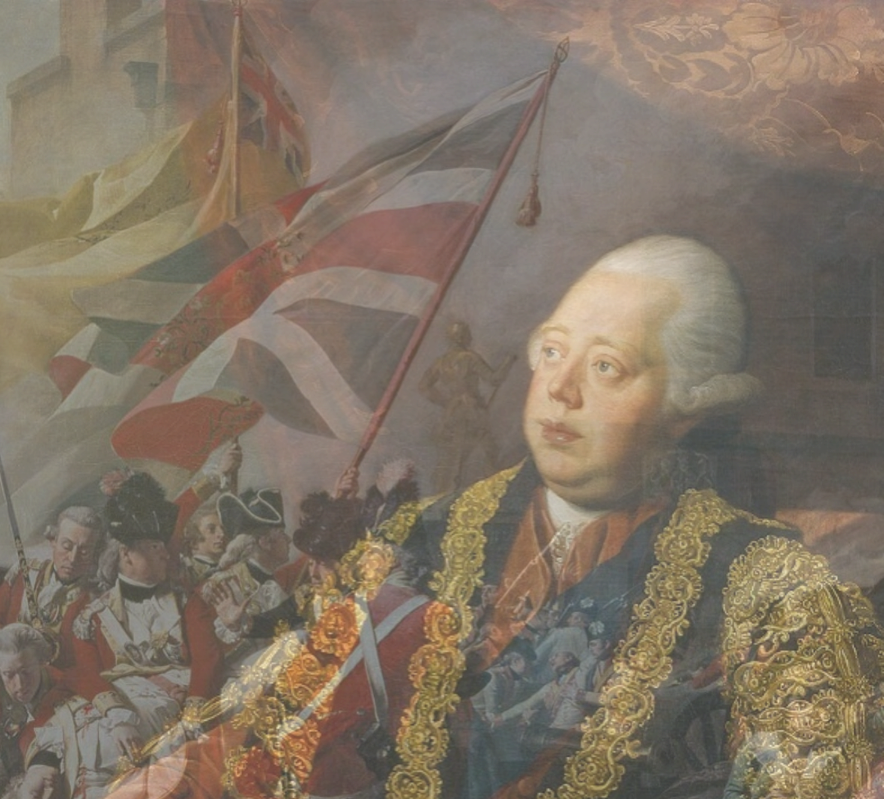
This year is the semiquincentennial (or 250th Anniversary) of the American Declaration of Independence. This two-part article by Jonathan Meakin looks at Lord North’s role in those momentous events.
In part one, we looked at North’s response to the growing trouble in North America after the Boston Tea Party, which culminated in the January 1775 Cabinet decision to ‘entreat his Majesty to take the most effectual methods to enforce due obedience to the laws and authority of the supreme legislature of Great Britain.”[0] In other words, to endorse the use of force to quell the troubles in America.
This second part looks at Lord North’s response to the crisis over the years that followed, as the American colonies slipped from his grasp entirely.
Read part 1 here
[0] Manuscripts of the Earl of Dartmouth, pp. 372-3.
A former Prime Minister intervenes
At a debate on the Boston Ports Act the 20 January 1775, in the House of Lords, no less a person than William Pitt the Elder, Lord Chatham stood to speak on the American crisis. Chatham had been Prime Minister during the 1760s and was the guiding force behind the 1757-62 Newcastle-Pitt government that had won the Seven Years’ War. To Georgian England, William Pitt was a patriotic hero, and one of the few Eighteenth Century politicians to have genuine popularity, even if it had been somewhat tarnished by his decision to accept a peerage, becoming the Earl of Chatham or Lord Chatham, in 1766.
Chatham was also a hero in the American colonies. During the Seven Years’ War, it had been his intervention that had made the North American theatre the top priority, and he insisted that the money be provided to pay for colonial forces. During the 1760s, he had defended the rights of the colonies against taxation.[1] His popularity endured, with many places, streets, and towns named after him across the Thirteen Colonies (including the city of Pittsburgh).
By in January 1775, Chatham was elderly, and when he stood in the Lords he might well have worn bandages from persistent and painful gout. Yet, he was still capable of the sort of passionate oration with which he’d made his name decades before.
“This resistance to your arbitrary system of taxation might have been foreseen: it was obvious from the nature of things, and of mankind; and above all, from the Whiggish spirit flourishing in that country. The spirit which now resists your taxation in America, is the … same spirit which established the great fundamental, essential maxim of your liberties – that no subject of England shall be taxed but by his own consent…I trust it is obvious to your lordships, that all attempts to impose servitude upon such men, to establish despotism over such a might continental nation, must be vain, must be fatal…undo these violent oppressive acts: they must be repealed’. [2]
Chatham’s young son wrote to his mother the following day to say that:
‘Nothing prevented his speech from being the most forcible that can be imagined, and administration fully felt it…The Ministry were violent beyond expectation, almost to madness. Instead of recalling the troops now there, they talked of sending more.’
Just over eight years later, that son would become Prime Minister himself – William Pitt the Younger.[3]
Chatham returned to the House of Lords on the 2 February with a conciliatory plan. He proposed to end the trouble by withdrawing the troops from Boston, repealing the Coercive Acts, and suspending the punitive measures. He went far further than many opposition figures, even suggesting that ‘the general congress’ meeting in Philadelphia could be ‘organised and empowered to adjust and fix the proportions of the general contribution’. He said that the Colonies should have the right to internal taxes and raise their own revenue. Britain, he argued, should preserve imperial unity, creating a sort of federal system.
On the matter of Colonial taxation, Chatham proposed ‘no Tallage, Tax, or other Charge for His Majesty’s Revenue, shall be commanded or levied from British Freemen in America, without Common Consent, by act of Provincial Assembly there, duly convened for that Purpose’. Colonial self-taxation would be recognised as a constitutional right:‘America shall be restrained within their ancient limits’.[4]
North’s ministers considered Chatham’s plan, but chose to reject it.[5] The Lords ultimately rejected the plan by 61 to 32 on 1 February 1775.[6] Benjamin Franklin, the American writer and polymath, watched from the galleries:
‘To hear so many of the Hereditary Legislators declaiming so vehemently against, not Adopting merely, but even the Consideration of a Proposal so important in its Nature, offered by a Person of so weighty a Character … gave me an exceeding mean Opinion of their Abilities, and made their Claim of Sovereignty over three Millions of virtuous sensible People in America, seem the greatest of Absurdities, since they appear’d to have scarce Discretion enough to govern a Herd of Swine.’ [7]
By contrast, George III wrote in a letter to Lord North of his:
‘infinite satisfaction…Nothing can be more calculated to bring the Americans to a due submission than the very handsome majority that at the outset have appeared in both Houses of Parliament.’ [8]

[1] St Germain, ‘William Pitt’s Stamp Act Speech’, AmericanRevolution.org.
[2] Parliamentary History of England, Vol. XVIII, Ref. 154-156.
[3] William Stanhope Taylor & Captain John Henry Pringle (eds.), Correspondence of William Pitt, Earl of Chatham, Volume IV, p. 376-77.
[4] Parliamentary History of England, Vol. XVIII, Ref. 150-168.
[5] Lucas, Lord North, Vol. II, p. 30-31[6] Parliamentary History of England, Vol. XVIII, Ref. 198-204
[7] ‘Benjamin Franklin to William Franklin: Journal of Negotiations in London, 22 March 1775’, Founders Archives.
[8] Bodham Donne (ed.), Correspondence of King George the Third with Lord North, pp. 224-225.


