In his war memoirs, Winston Churchill wrote that ‘Future generations may deem it noteworthy that the supreme question of whether we should fight on alone never found a place on the War Cabinet agenda.’[1]
But, this wasn’t quite true…
Over three days, in May 1940, in an atmosphere of uncertainty and doubt, the Cabinet discussed whether Britain’s participation in the Second World War should continue. This article uses excerpts from confidential minutes to shine a light on these meetings.
[1] Winston Churchill, The Second World War: The Gathering Storm, p. 157. Quoted in Roberts, Churchill, p. 542.
Image credit: Trafalgar Square, London, September 1940, Alamy C1E4PE
Context
The rise of the dictators and appeasement.
Britain met the rise of the dictators during the 1930s with a policy of diplomatic appeasement and rearmament. Prime Minister Neville Chamberlain desperately hoped to avoid a repeat of the horrors of the First World War.
In September 1938, he flew to Germany to meet dictator Adolf Hitler to negotiate an agreement over Czechoslovakian borders. Hitler had declared that the German speaking lands in the country’s Sudetenland should be given to Germany or he would take them by force. Ultimately, Britain and France gave Hitler what he wanted, in return for assurances that Germany would attempt no more expansion. Chamberlain returned to Britain a hero after the Munich Conference on 30 September 1938. When he arrived at Heston aerodrome, he declared ‘Peace for our time’[2]
But Hitler had no intention of keeping his word. On 16 March 1939, Germany invaded what was left of Czechoslovakia. In response, on 30 March, Chamberlain’s government guaranteed the borders of Poland, Greece, and Romania – a warning that further German expansion would be resisted by British arms.
When Germany attacked Poland on 1 September 1939, Britain issued an ultimatum demanding they withdraw. This was ignored. On 3 September 1939, at 11.15 am Chamberlain sat in the Cabinet Room to read out a statement to the nation declaring war on Germany.
I am speaking to you from the Cabinet Room at 10 Downing Street. This morning the British ambassador in Berlin handed the German government a final note stating that unless we heard from them by 11 o’clock that they were prepared at once to withdraw their troops from Poland, a state of war would exist between us. I have to tell you now that no such undertaking has been received, and that consequently this country is at war with Germany.
For Winston Churchill, the late 1920s and the 1930s were ‘wilderness years’. He had retained a parliamentary seat, but as a former Chancellor and First Lord of the Admiralty, he was considered a ‘has been’. His reputation was tainted by the military disaster of Gallipoli in 1915, followed by debacles over Ireland and the Gold Standard in the 1920s. He spent his time writing and went on two speaking tours of the United States. These activities that helped his somewhat precarious finances.
Churchill adamantly spoke out against Indian independence. In 1931, he resigned from the Shadow Cabinet because Tory leader Stanley Baldwin favoured Indian reform. When Baldwin became Prime Minister again in 1935, he found no place for the meddlesome Churchill on the frontbench.
From the backbenches, Churchill warned the Commons about the rise of Hitler and Nazi Germany. He opposed appeasement and, thanks to some leaked data supplied by Foreign Office sympathisers, was able to expose the extent of Nazi rearmament. As the years went by, Churchill came to be seen as a prophet and resolute enemy of the Nazis.
When war began in September 1939, Chamberlain believed that Churchill’s presence would strengthen his government and asked him to return as First Lord of the Admiralty. This was the same position that Churchill had in 1914 when the First World War began, 25 years before.
Allied strategy and The Phoney War
Churchill justified his presence in government quickly. In December, a German cruiser, the Admiral Graf Spee was damaged and cornered by the Royal Navy off the coast of South America. The German Captain chose to scuttle his ship, thereby lending the British their first real victory of the war. While his role in operations was small, it still reflected well on Churchill. In February 1940, Churchill ordered the seizure of a German supply ship in neutral Norwegian waters, liberating 300 British prisoners. Through these victories, he gained a reputation as an energetic minister, keen to take the war to the enemy.
However, outside of the Admiralty, there was little enthusiasm or dynamism about the British or Allied war effort. Allied strategy was to sit behind fortifications and await attack, thereby avoiding the bloody and futile frontal attacks that had characterised the first weeks of the First World War. The defence primarily rested with the French army, which was considered to be very strong with 2.2 million men, and was well equipped with modern tanks, artillery, and aircraft. Meanwhile, the Allies hoped that a British-led naval blockade would damage the German economy and air attacks would ruin their industrial capacity. However, this passive approach handed the strategic initiative to Germany, which had conquered Poland and now looked West.
For a while, the war’s inactivity lulled the British into a false sense of security. The predicted waves of German bombers had not destroyed British cities. No German invasion had crossed into France or the Low Countries. In early April, Neville Chamberlain told the House of Commons that Hitler had ‘missed the bus’.
Image credit: The burning wreck of the German cruiser Admiral Graf Spee, YorkSpace Institutional Repository, Public Domain, via Wikimedia Commons
Norway
Image credit: German troops advance in Norway, Borchert, Erich, CC-BY-SA 3.0, CC BY-SA 3.0 DE via Wikimedia Commons
Six days after Chamberlain boasted of Hitler missing the bus, German forces invaded Norway. The Germans quickly seized ports and strategic areas, but the Allies counterattacked in mid-April. The difficult terrain, poor logistics, and the German air superiority hampered the early Allied efforts. Critics worried about a repetition of Gallipoli.
At sea, the Royal Navy devastated the German navy, inflicting losses upon its surface fleet from which it never recovered. British losses were also heavy, including an aircraft carrier and a heavy cruiser, but the Royal Navy was far bigger than the Kriegsmarine.
By May, the British and Norwegian forces had reconquered Narvik, the first Allied land victory of the war. However, the disaster in France would result in full Allied withdrawal in June.
Norway debate
At the nadir of the Norway campaign, in early May, Parliament debated the course of the war. It was one of the most dramatic debates in British history. For two days, from 7-9 May, speakers attacked the government for its conduct in the war, despite Churchill’s best efforts at speaking in defence.
Clement Attlee: “I say that the House of Commons must take its full responsibility. I say that there is a widespread feeling in this country, not that we shall lose the war, that we will win the war, but that to win the war, we want different people at the helm from those who have led us into it.”[3]
On 8 May, a No Confidence Vote was held. The government won by 81 votes, but over a third of Conservative backbenchers had abstained. It was clear that something had to change.
Over 9-10 May, Chamberlain urgently tried to construct a wartime coalition with the Liberals and the Labour Party. Attlee told Chamberlain that while Labour was willing to join a coalition, it would require a change of Prime Minister: Attlee told Chamberlain that ‘our party…won’t have you and I think I am right in saying the country won’t have you either’.[4]
[3] ‘Conduct of the War’, HC Debs, Vol 360, Col 1094, 7 May 1940. [4] Self, Chamberlain, p. 429.
Churchill becomes Prime Minister
Image credit: Churchill’s wartime coalition Cabinet in October 1941, IWM (HU 55505)
Germany invaded France, Belgium and the Low Countries on the morning of 10 May 1940. Cabinet met three times, each time digesting the confused reports from the frontline. Chamberlain briefly considered whether it was his responsibility to stay. But, at 4.30pm, he once again spoke to Attlee, who confirmed that Labour would not join a government under him. Chamberlain went to the Palace a few minutes later.
The Conservative Party’s grandees had met on the 9 May to decide who would be the next Prime Minister. It came down to a choice between Lord Halifax and Winston Churchill. Halifax was favoured by many in the Conservative Party, but Churchill was much more popular in the country. Halifax made the decision by ruling himself out; he said that it was not possible to lead a government from the House of Lords, instead of the Commons.
Thus, on 10 May 1940, Neville Chamberlain resigned and Winston Churchill was appointed Prime Minister.
As he went to bed that night at 3am, Churchill later wrote: ‘I was conscious of a profound sense of relief. At last I had the authority to give directions over the whole scene. I felt as if I were walking with destiny, and that all my past life had been preparation for this hour and this trial.’[5]
In a speech on 13 May, Churchill told Parliament:
“I have nothing to offer but blood, toil, tears and sweat”. We have before us an ordeal of the most grievous kind. We have before us many, many long months of struggle and of suffering. You ask, what is our policy? I will say: It is to wage war, by sea, land and air, with all our might and with all the strength that God can give us; to wage war against a monstrous tyranny never surpassed in the dark and lamentable catalogue of human crime. That is our policy. You ask, what is our aim? I can answer in one word: it is victory, victory at all costs.’[6]
But not everyone was convinced: many Conservative MPs were sceptical, and the cheers were louder from the Labour benches.
[5] Churchill, The Gathering Storm, P. 601. [6] “His Majesty’s Government”, House of Commons Debates, vol. 360, Hansard, cc1502, 13 May 1940.
Background
Over the 26 to 28 May, the War Cabinet met nine times.[7] The discussions took place in Admiralty House, in the Cabinet Room of 10 Downing Street, and concluded in the House of Commons on 28 May.
The discussions over late May would take place against a backdrop of military disaster, uncertainty about Italy’s intentions, and a number of ‘Known Unknowns’ – things that the Cabinet knew that they did not know.
German forces invaded France and Low Countries on 10 May 1940. The Germans invaded through the dense Ardennes forest, which the Allies had considered impenetrable.
On 12 May 1940, the German army seized the strategically important French town of Sedan, allowing them to cross the River Meuse. For almost a week, the French army urgently attacked the Germans, trying to force them back. But German air superiority enabled them to strike at the French forces with precision. By the end of the 17 May, the French counterattacks were defeated, with devastating losses.
Sedan was a military disaster for the Allied cause. The Germans had outflanked the strong Maginot Line defences, and there were no longer any fixed positions between the Germans and the English Channel. With the French defeat, the Germans could push quickly into undefended French territory to the West, cutting through the Pas de Calais, and separating the French and British commands.
After the battle, French morale collapsed. Some of their best units had been destroyed in the fighting at Sedan, and there was no strategy to defend the country anymore. The French generals had calculated that fixed defences would stop the Germans, as they had during the First World War. With the failure of their meticulously prepared plans, the French generals became listless and defeatist. On 16 May 1940, Churchill visited France and asked French supreme commander Gamelin ‘Where is the strategic reserve’, only to be told ‘Aucune’ [‘None’].
On 19 May, Churchill spoke to the nation over the radio. He tried to put a brave face on things, saying that ‘I have invincible confidence in the French Army and its leaders.’[8] But, it was soon clear that the Allies were heading for military collapse in Northern France.
Image credit: Battle of Belgium 1940 The History Dept of US Military Academy, Public Domain, via Wikimedia Commons
This map shows the Allied predicament on 21 May 1940. The strong Maginot line defences are the thick blue line to the bottom right. The Allies had expected to fight Belgium, but the German attack in the Ardennes had shocked them, and the subsequent German ‘sickle cut’ pushed to the cost, severing the Allied front.
Image credit: German tanks cruise down French roads in May 1940, Bundesarchiv, Bild 101I-127-0396-13A, Huschke, CC-BY-SA 3.0 via Wikimedia Commons
German forces pushed West from Sedan. In the sunny weather, their tanks cruised down the tree-lined roads, meeting little opposition. German officers were instructed to refuel at petrol stations and press on rapidly. Overhead, German aircraft ruled the skies, bombing and strafing the Allied forces with impunity, turning retreat into rout.British forces withdrew north, towards the Channel, congregating around the city of Dunkirk. French forces were divided, with some withdrawing to the River Somme, and others joining the British. The best part of a third of a million Allied soldiers, including virtually the entire British Expeditionary Force was now crowded inside a narrow perimeter, being ground down by the Germans on three sides. The British began to plan an evacuation.
On 23 May, the German army reached Cap Griz Nez, from which they could see the English coast just 20 miles away. A few miles to the West, German forces surrounded Calais. Churchill ordered the commander, Brigadier Claude Nicholson to fight until the end. The town was destroyed, and the defenders killed or captured, but the British believed that the doomed battle had bought them time.[9]
On 24 May, Hitler issued a ‘Halt Order’, ordering his armies to stop their attacks. His reasoning for this decision was never clearly explained. However, it seems that he thought that the German forces needed to consolidate their positions, and that the German air force could be trusted to inflict losses on the besieged British troops. For 48 critical hours, the German tanks stood still.
The question remained, could any part of the Allied armies now surrounded on three sides at Dunkirk be rescued?
The Cabinet discussions were also influenced by other factors.
What might the Americans be prepared to do to help Britain? President Franklin Roosevelt was known to be contemplating a fourth term as President. He was sympathetic to Britain, but he also had to contend with a strong isolationist movement in American politics that might prevent his re-election. The British wanted to make clear that they would continue to fight and that they needed American resources. But they were also cautious of looking weak. If the Americans thought that British defeat was inevitable, they would not throw good money after bad.
Was the German war machine more brittle than it appeared? British intelligence believed that Hitler was ‘working to a timetable’ and had to win by the end of the year. After that, they believed that the pressures of the Allied blockade and Germany’s fuel shortages would become intolerable. Was it simply a matter of holding out for half a year or so?
Could the Germans invade Britain? The Cabinet ministers could not rule out an invasion of Britain if France fell. After all, Germany had achieved something that was seen as impossible; they had smashed through the Allied lines and looked set to defeat France in a matter of weeks. If their paratroopers were dropped over southern England, would it be possible to defeat them?
How strong was the risk of air attack? Stanley Baldwin, Britain’s interwar Prime Minister, had predicted that ‘the bomber will always get through’.[10] There was a deep fear that the German bomber aircraft would lay waste to Britain’s cities and rapidly destroy its industries. Was it possible that the country would simply face devastation at the hands of the German air force if it fought on alone? At the height of the Cabinet Crisis, the Chief of the Air Staff told the ministers that the most important thing was ‘preventing the Germans from achieving such air superiority as would enable them to invade this country.’[11]
Could France be convinced to continue the war? Even in the midst of defeat, France possessed both the world’s second largest Empire and a large modern navy. If the French government could be persuaded to flee to Algeria (then considered a part of Metropolitan France), they might be able to continue the struggle.
And perhaps the biggest question of all was how much of the army could be saved from France? What condition would it be in? Much of Britain’s pre-war regular army, including large numbers of trained officers and men, was in France. The loss of this force, together with the certain loss of all of their heavy equipment, would be a bitter blow to Britain’s prospects.
Ultimately, the War Cabinet had no answers to these questions, only informed opinions.
[10] ‘International Affairs’, HC Deb 10 November 1932 vol 270 cc632. [11]CAB 65/13/20
Italy
The biggest questions concerned Italy.
Italy, led by fascist dictator Benito Mussolini, had remained neutral during the great European crisis. While he was sympathetic towards Hitler, the Italian military was not ready for war. Intervention in the Spanish Civil War had been rewarded with fascist victory, but it had also been costly, with large amounts of Italian equipment being used up.
But Mussolini was vain, and he was feeling overshadowed by Hitler’s military triumphs. After all, he was the original fascist leader. He wanted to redraw the map and found a new Roman Empire from territory in the Balkans and Africa. The Italian navy was modern and considered very formidable. It could cause great difficulties for the British in the Mediterranean. Moreover, by May 1940, the momentum seemed to be with Hitler’s forces, and if Italy did not participate, there would be no leverage for them at the peace conference. Mussolini later told one of his generals: ‘I only need a few thousand dead so that I can sit at the peace conference as a man who has fought’.[12]
Three questions dominated the British government’s thinking:
What would it take to keep Italy out of the war?
Would Italy be prepared to mediate to end the war?
If Italy was interested in mediation, could they influence the Germans to produce moderate terms that might end the war, without threatening Britain’s independence?
In May 1940, the British government still hoped that Italy could be kept out of the war. On the afternoon of 25 May 1940, Foreign Secretary Lord Halifax had met the Italian ambassador to discuss what terms Italy might ask for to avoid entering the conflict.[13]
Vain and feeling overshadowed. Was Mussolini prepared to talk peace or wage war?
Churchill became Prime Minister on 10 May 1940. While his far-sighted criticism of appeasement and energetic Admiralty leadership gave him the premiership, the Conservative Party had mixed feelings about the eccentric and freewheeling Churchill.
Image credit: Lord Halifax, 1944, by Yousuf Karsh, CC BY-SA 3.0 NL via Wikimedia Commons
Lord Halifax, Foreign Secretary
Halifax was a Conservative grandee and aristocrat. He had been Viceroy of India over 1926-31 and had served in a variety of government positions since the beginning of the 1920s. Like Churchill, Halifax had seen war, having served on the Western Front in 1916. Halifax had been an architect of appeasement, but had turned against the policy in early 1939, when he realised that Hitler could not be trusted. Churchill had appointed Halifax Foreign Secretary.
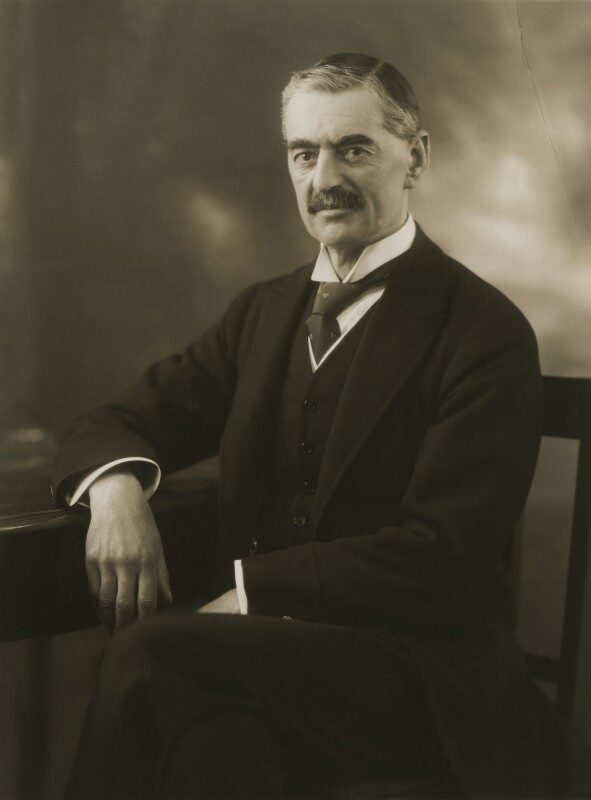
Neville Chamberlain, Lord President of the Council
Chamberlain had been Prime Minister from 1937-40. While his strategy of appeasement had failed and he had resigned from the premiership, he continued to be leader of the Conservative Party and sat in the War Cabinet as Lord President of the Council. Chamberlain’s views would sway a large part of the Conservative parliamentary party.
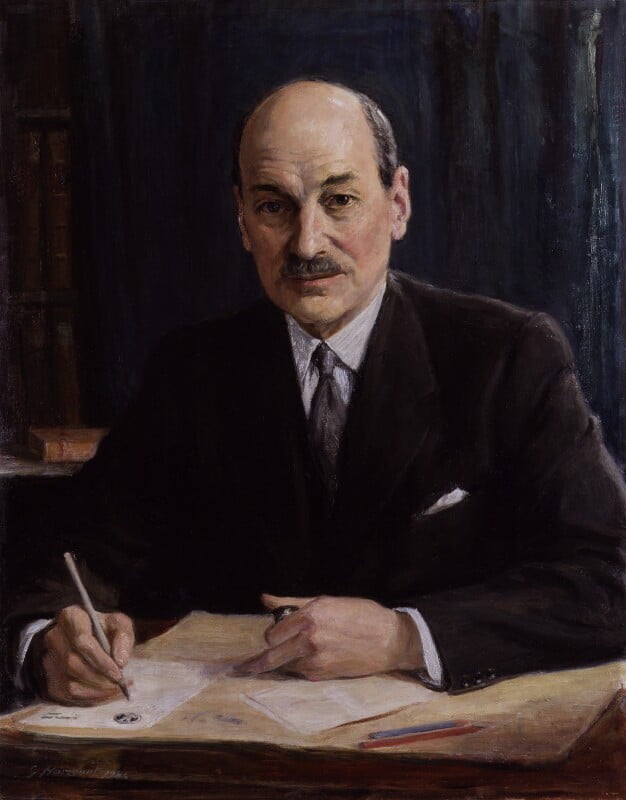
Leader of the Labour Party since 1935, Attlee had served during the First World War, and been the penultimate man to leave Suvla Bay at Gallipoli in 1915. He had made the decision to join the wartime coalition just weeks before. Unlike the Conservatives, the Labour Party was much more united in opposition to fascism and support for Churchill. Churchill had appointed him Lord Privy Seal, and made him a member of the War Cabinet.
Image credit: Arthur Greenwood (1880-1954), British Labour politician, Alamy 2M3K9C9
Arthur Greenwood, Minister Without Portfolio
Greenwood was Deputy Leader of the Labour Party. In September 1939, as Attlee was in hospital, it was Greenwood who had attacked Chamberlain for his apparent ambivalence over the invasion of Poland. He sat in the wartime government as Minister Without Portfolio.
While not a full member of the War Cabinet, Liberal Party leader Archibald Sinclair was invited by Churchill to attend in his capacity as Secretary of State for Air. He was another veteran of the Western Front, where he’d served alongside Winston Churchill. Churchill asked him to attend the meetings, ostensibly as leader of the Liberal Party, but also because he was an old friend.
26 May: Mediation raised
On the morning of Sunday 26 May, Cabinet met at 9am. The military news continued to be bleak.
During the discussion, Lord Halifax told the War Cabinet that he had had an interview, with the Italian Ambassador, Giuseppe Bastiannini, the previous evening. The ambassador ‘had clearly made soundings as to the prospect of our agreeing to a conference’. Halifax told the ambassador that ‘provided our liberty and independence were assured’, Britain might be prepared to discuss peace.
Churchill quickly dismissed the approach: ‘peace and security might be achieved under a German domination of Europe. That we could never accept. We must ensure our complete liberty and independence. He was opposed to any negotiations which might lead to a derogation of our rights and power.’
Chamberlain replied that it was likely that ‘Italy would come in on Germany’s side’, and that only a positive French reply might prevent this. The French were keen to avoid this, because it would mean another frontline.
Clement Attlee kept an open mind, saying that he ‘thought that Mussolini would be very nervous of Germany emerging as the predominant power in Europe’.
Halifax observed that the French could say that they were bound not to make a separate peace, and they could use Britain’s position to bargain for good terms for both countries. Chamberlain asked whether ‘Italy could be bought off?’, after all ‘Italy’s demands were likely to be largely at the expense of France’, at least preventing their joining the war. Churchill thought this was worth ‘bearing in mind’.
After this brief discussion, the meeting focused on a paper from the Chiefs of Staff on whether Britain could continue the war alone.[14]
A second meeting began at 2pm. At lunchtime, Churchill had met French Prime Minister Paul Reynaud. According to Churchill, French Supreme Commander Weygand believed that ‘the Germans with their superiority of numbers and tanks, could pierce the line…he did not think that France’s resistance was likely to last very long against a determined German onslaught.’ Churchill had encouraged the French to stay in the war, but Reynaud seemed pessimistic.[15]
Reynaud’s pessimism cast a shadow over the 2pm meeting. Halifax brought up the proposed approach to France again.[16] What if an offer of terms was made and refused?
The War Cabinet met again at 4, with part of the meeting unminuted. However, it is clear from what minutes there are, that the matter of mediation was again discussed.
THE PRIME MINISTER said that his general comment on the suggested approach to Signor Mussolini was that it implied that if we were prepared to give Germany back her colonies and to make certain concessions in the Mediterranean, it was possible for us to get out of our present difficulties. He thought that no such option was open to us. For example, the terms offered would certainly prevent us from completing our re-armament
THE FOREIGN SECRETARY said that, if so, the terms would he refused, but he felt sure that Signor Mussolini must feel in a most uncomfortable position.
THE PRIME MINISTER said that Herr Hitler thought that he had the whip hand. The only thing to do was to show him that he could not conquer this country. If on M . Reynaud’s showing, France could not continue, we must part company. At the same time, he did not raise objection to some approach being made to Signor Mussolini.
THE FOREIGN SECRETARY then read to the War Cabinet the draft which had been discussed that afternoon with M. Reynaud…
THE MINISTER WITHOUT PORTFOLIO [Greenwood] thought that Signor Mussolini would be out to get Malta, Gibraltar and Suez. He felt sure that the negotiations would break down; but Herr Hitler would get to know of them, and it might have a bad effect on our prestige.[17]
[17] 139th Conclusions: Confidential Annex’, 26 May 1940, CAB: 65/13/20
Further reading
Dynamo
On 26 May, at 7pm, Churchill authorised Operation Dynamo, the evacuation of the trapped, and predominantly British, military forces from Dunkirk.
Image credit: Dunkirk evacuation, 26-29 May 1940, IWM (NYP 68075)
For the next week, over a thousand British and Allied ships were involved in a massive evacuation operation. The French army held the collapsing perimeter and few of them would escape. The British army would also have to leave behind all of their tanks, artillery, and other heavy equipment.
Further reading
A Bleak Message
That evening, a bleak report arrived from Lord Lothian, the British ambassador in Washington. He had spoken to President Franklin Roosevelt. Roosevelt had wondered aloud ‘if things came to the worst’, that the British Royal Navy ships, and any available military equipment, should be treated ‘as Empire possessions’ and sent to Australia or Canada.
These powerful assets could not be allowed to fall into Hitler’s hands.
The ambassador asked whether the USA might be in the war at that point, but the President did not answer: ‘the decision rested not with himself, but Congress’. Though, he vaguely said that he ‘thought it probable’ that America would eventually go to war with Germany.
With that said, Roosevelt also added that the future seat of Britain’s government-in-exile should be Bermuda, not Ottawa in Canada. He was not comfortable with the British monarchy ‘being based on the American continent’.[18]
For the War Cabinet, much of the 27 May was spent dealing with the impending Belgian surrender, and the withdrawal of their forces from the war, including from part of the Dunkirk perimeter.
The War Cabinet largely discussed purely military and strategic questions.[19]
But, at 4.30pm, Cabinet met again for perhaps the most fraught meeting of the war. Initially, they discussed an approach to Mussolini that had been made via Roosevelt, with some scepticism expressed about whether the appeal was meaningful at all or had much real hope.
Archibald Sinclair, for example, said that he was ‘convinced of the futility of an approach to Italy at this time. Being in a tight corner, any weakness on our part would encourage the Germans and Italians, and would tend to undermine morale in this country… The suggestion that we were prepared to barter away pieces of British territory would have a deplorable effect and would make it difficult to continue the desperate struggle which faced us…’.
Halifax spoke in favour of the approach, saying it did not bind them to anything. ‘He doubted whether there was very much force in the argument that we must do nothing which gave an appearance of weakness, since Signor Mussolini would know that President Roosevelt’s approach had been prompted by us.’
Attlee interjected ‘In effect, the approach suggested would inevitably lead to our asking Signor Mussolini to intercede to obtain peace terms for us.’ Greenwood added that: ‘If it got out that we had sued for terms at the cost of ceding British territory, the consequences would be terrible…It would be heading for disaster to go any further with these approaches’.[20]
Chamberlain said that the response to the proposed mediation should not be a complete rejection, and ‘we ought to go a little further with it, in order to keep the French in good temper.’
Echoing Sinclair, Churchill said that he was: ‘increasingly oppressed with the futility of the suggested approach to Signor Mussolini, which the latter would certainly regard with contempt…If after 2 or 3 months we could show that we were still unbeaten our prestige should return. Even if we were beaten, we should be no worse off than we should be if we were now to abandon the struggle. Let us therefore avoid being dragged down the slippery slope with France’.[21]
THE PRIME MINISTER said… If the worst came to the worst, it would not be a bad thing for this country to go down fighting for the other countries which· had been overcome by the Nazi tyranny.
THE FOREIGN SECRETARY said that he saw no particular difficulty in taking the line suggested by the Lord President. Nevertheless, he was conscious of certain rather profound differences of points of view which he would like to make clear.
In the first place, he would have thought that, if we could persuade them to do so, there would have been some positive value in getting the French Government to say that they would fight to the end for their independence.
In the second place, he could not recognise any resemblance between the action which he proposed, and the suggestion that we were suing for terms and following a line which would lead us to disaster. In the discussion the previous day he had asked the Prime Minister whether, if he was satisfied that matters vital to the independence of this country were unaffected, he would be prepared to discuss terms. The Prime Minister had said that he would be thankful to get out of our present difficulties on such terms, provided we retained the essentials and the elements of our vital strength, even at the cost of some cession of territory. On the present occasion, however, the Prime Minister seemed to suggest that under no conditions would we contemplate any course except fighting to a finish. The issue was probably academic, since we were unlikely to receive any offer which would not come up against the fundamental conditions which were essential to us. If, however, it was possible to obtain a settlement which did not impair those conditions, he, for his part, doubted if he would be able to accept the view now put forward by the Prime Minister. The Prime Minister had said that two or three months would show whether we were able to stand up against the air risk. This meant that the future of the country turned on whether the enemy’s bombs happened to hit our aircraft factories. He was prepared to take that risk if our independence was at stake; but if it was not at stake he would think it right to accept an offer which would save the country from avoidable disaster.
THE PRIME MINISTER said that he thought the issue which the War Cabinet was called upon to settle was difficult enough without getting involved in the discussion of an issue which was quite unreal and was most unlikely to arise. If Herr Hitler was prepared to make peace on the terms of the restoration of German colonies and the overlordship of Central Europe, that was one thing. it was quite unlikely that he would make any such offer.
THE LORD PRESIDENT OF THE COUNCIL thought that if concrete proposals were put before the War Cabinet there would be no difficulty in settling what were and what were not essential.
THE FOREIGN SECRETARY said he would like to put the following question. Suppose the French Army collapsed and Herr Hitler made an offer of peace terms. Suppose the French Government said “We are unable to deal with an offer made to France alone and you must deal with the Allies together.” Suppose Herr Hitler, being anxious to end the war through knowledge of his own internal weaknesses, offered terms to France and England, would the Prime Minister be prepared to discuss them?
THE PRIME MINISTER said that he would not join France in asking for terms; but if he were told what the terms offered were, he would be prepared to consider them.
THE LORD PRESIDENT OF THE COUNCIL thought that Herr Hitler’s tactics were likely to be that he would make a definite offer to France, and when the French said that they had allies he would say “I am here, let them send a delegate to Paris.”
The War Cabinet thought that the answer to such an offer could only be “No”.[22]
It seems at this point that Halifax threatened, or at least suggested, that the time had come for him to resign. Halifax had told Alexander Cadogan, the Permanent Secretary at the Foreign Office, ‘I can’t work with Winston any longer.’[23] Halifax later wrote in his diary: ‘I thought Winston talked the most frightful rot’.[24] Churchill’s premiership was less than a month old, and Halifax’s resignation would have triggered a political crisis.
Churchill soothed Halifax with a walk in Number 10 garden. We’ll never know what was said, but it is likely Churchill aimed to calm and reassure Halifax.[25]
The War Cabinet met again that evening, to discuss Belgium’s surrender.[26]
[22]CAB 65/13/23 [23]Cadogan, The diaries of Sir Alexander Cadogan, pp. 290-91. [24]Lukacs, Five Days in London, p. 153. [25]Lukacs, Five Days in London, p. 153-5. [26]Lukacs, Five Days in London, p. 156.
28 MAY: The decisive day
The news continued to be bleak. The Italians had responded to Roosevelt’s approach in a ‘hostile’ manner. It now seemed likely that the Italians would go to war.[27]
Image credit: Parliament in 1940, Alamy BN3Y7N, V&A Images
The War Cabinet now met at 4pm, in the House of Commons. Unlike before, when many topics had been discussed, sometimes simultaneously, the only topic of this meeting was to ‘consider a message received from the French Government again proposing that a direct approach should he made to Italy by France and this country.’
THE PRIME MINISTER said that it was clear that the French purpose was to see Signor Mussolini acting as intermediary between ourselves and Herr Hitler. He was determined not to get into this position.
THE FOREIGN SECRETARY said that the proposal which had been discussed with M. Reynaud on Sunday had been as follows: that we should say that we were prepared to fight to the death for our independence, but that, provided this could be secured, there were certain concessions that we were prepared to make to Italy.
THE PRIME MINISTER thought that the French were trying to get us on to the slippery slope. The position would be entirely different when Germany had made an unsuccessful attempt to invade this country.
THE LORD PRESIDENT OF THE COUNCIL [Chamberlain] said that there could he no question of our making concessions to Italy while the war continued. The concessions which if contemplated we might have to make, e.g., in regard to Malta and Gibraltar, would have to be part of a general settlement with Germany. No settlement with Italy which left Germany still at war would be of any value to us.
…THE FOREIGN SECRETARY agreed that there was little prospect that anything would result from an approach on the lines suggested by the French. At the same time, the larger issue was also involved. Assuming that Signor Mussolini wished to play the part of mediator, and that he could produce terms which would not affect our independence, he thought that we ought to be prepared to consider such terms. He agreed, however, that this hypothesis was a most unlikely one.
THE SECRETARY OF STATE FOR AIR [Sinclair] thought that there was no possible chance of acceptable terms being open to us at the present moment.
THE FOREIGN SECRETARY said that we must not ignore the fact that we might get better terms before France went out of the war and our aircraft factories were bombed, than we might get in three months’ time.
…THE PRIME MINISTER said that he came back to the point that the French wanted to get out of the war, but did not want to break their Treaty obligations to us. Signor Mussolini, if he came in as mediator, would take his whack out of us. It was impossible to imagine that Herr Hitler would be so foolish as to let us continue our re-armament. In effect, his terms would put us completely at his mercy. We should get no worse terms if we went on fighting, even if we were beaten, than were open to us now. If, however, we continued the war and Germany attacked us, no doubt we should suffer some damage, but they also would suffer severe losses. Their oil supplies might be reduced. A time might come when we felt that we had to put an end to the struggle, but the terms would not then be more mortal than those offered to us now.
THE FOREIGN SECRETARY said that he still did not see what there was in the French suggestion of trying out the possibilities of mediation which the Prime Minister felt was so wrong.
THE LORD PRESIDENT OF THE COUNCIL [Chamberlain] referred to …the line which had been agreed with M. Reynaud in the conversations on Sunday. It was clear to the world that we were in a tight corner, and he did not see what we should lose if we said openly that, while we would fight to the end to preserve our independence, we were ready to consider decent terms if such were offered to us.
The Lord President said that, on a dispassionate survey, it was right to remember that the alternative to fighting on nevertheless involved a considerable gamble. The War Cabinet agreed that this was a true statement of the case.
THE PRIME MINISTER said that the nations which went down fighting rose again, but those which surrendered, tamely were finished.
THE MINISTER WITHOUT PORTFOLIO [Greenwood] said that any course which we took was attended by great danger. The line of resistance was certainly a gamble, but he did not feel that this was a time for ultimate capitulation.
THE FOREIGN SECRETARY said that nothing in his suggestion could even remotely be described as ultimate capitulation.
THE PRIME MINISTER thought that the chances of decent terms being offered to us at the present tune were a thousand to one against.
THE LORD PRESIDENT OF THE COUNCIL [Chamberlain] said that it was our duty to look at the situation realistically. He felt bound to say that he was in agreement with the Foreign Secretary in taking the view that if we thought it was possible that we could now get terms which, although grievous, would not threaten our independence, we should be right to consider such terms.
Again, looking at the matter realistically, he did not think it could be said that an approach to Signor Mussolini on the lines proposed by the French at the present time would be likely to produce an offer of decent terms, certainly not with Paris in Herr Hitler’s grasp, but uncaptured. He therefore concluded that it was no good making an approach on the lines proposed by M. Reynaud at the present time. On the other hand, he thought that if we were not very careful as to the terms of our answer, France might give up the struggle at once. He did not want to give her any pretext for doing so.
General agreement was expressed with this view.[28]
***
For 5pm, Churchill had asked for the Outer Cabinet to convene, those ministers not in the War Cabinet. They filed into the House of Commons Committee room to be briefed by the Prime Minister. Churchill recalled that ‘we were perhaps twenty-five round the table’, and he delivered his remarks sitting.
Churchill told them the truth. The situation in France was likely to be ‘the greatest British military defeat for many centuries’. As a consequence, he had considered whether he should enter negotiations with Hitler. However, he believed that negotiation now would be disastrous: ‘The Germans would demand our fleet – that would be called “disarmament” – our naval bases, and much else. We should become a slave state’ with a government ‘under Mosley or some such person’.
He told them that it would be better to ‘fight it out’. And he concluded that: ‘If this long island story of ours is to end at last, let it end only when each one of us lies choking in his own blood upon the ground.’[29]
Churchill recalled the response, from ‘twenty-five experienced politicians and Parliament men’ as surprising: ‘Quite a number seemed to jump up from the table and come running to my chair, shouting and patting me on the back.’ He felt that this moment was critical: ‘There is no doubt that had I at this juncture faltered at all in the leading of the nation I should have been hurled out of office. I was sure that every minister was ready to be killed… rather than give in. In this they represented the House of Commons and almost all the people.’[30]
The War Cabinet reconvened at 7pm. Buoyed by the meeting with the Outer Cabinet, he now rejected any peace proposal
THE PRIME MINISTER said that in the interval he had seen the Ministers not in the War Cabinet. He had told them the latest news. They had not expressed alarm at the position in France, but had expressed the greatest satisfaction when he had told them that there was no chance of our giving up the struggle. He did not remember having ever before heard a gathering of persons occupying high places in political life express themselves so emphatically…
… THE PRIME MINISTER thought that an appeal to the United States [to mediate] at the present time would be altogether premature. If we made a bold stand against Germany, that would command their admiration and respect; but a grovelling appeal, if made now, would have the worst possible effect. He therefore did not favour making any approach on the subject at the present time.
The wording was agreed for a reply to the French proposal for talks.
***
That evening, at twenty minutes to midnight, a telegram was sent from Churchill to the British ambassador in Paris to be passed on to French Prime Minister Paul Reynaud.
‘I have with my colleagues examined with the most careful and sympathetic attention the proposal for an approach by way of precise offer of concessions to Signor Mussolini that you have forwarded to me today, fully realising the terrible situation with which we are both faced at this moment… we are convinced that at this moment when Hitler is flushed with victory and certainly counts on early and complete collapse of Allied resistance, it would be impossible for Signor Mussolini to put forward proposals for a conference with any success. I may remind you also that the President of the U.S.A. has received a wholly negative reply to the proposal which we jointly asked him to make and that no response has been made to the approach of Lord Halifax made to the Italian Ambassador here last Saturday…
…Therefore, without excluding the possibility of an approach to Signor Mussolini at some time, we cannot feel that this would be the right moment and I am bound to add that in my opinion the effect on the morale of our people, which is now firm and resolute, would be extremely dangerous. You yourself can best judge what would be the effect in France…’
Churchill’s message rejected the possibility of joining France in asking for mediation. The Cabinet crisis was over. There would be no peace with Nazi Germany.
[27]Cadogan, The diaries of Sir Alexander Cadogan, p. 291. [28]CAB 65/13/23 [29]Hastings, Finest Years, p. 37. [30]Churchill, Their Finest Hour, p. 88.
Consequences
Image credit: British army evacuation from Dunkirk, May-June 1940, IWM (H 1637)
Dunkirk
Overall, 338,226 Allied soldiers were rescued from Dunkirk by 4 June. Crucially, 225,000 of them were British, and they would form the core of Britain’s armies over the long years of war ahead.
Churchill warned that ‘We must be very careful not to assign to this deliverance the attributes of a victory. Wars are not won by evacuations.’ Nevertheless, the escape was hailed as a ‘miracle’ and, in the dark days of 1940, it measurably improved British morale.
The End in France
British determination and the miracle of Dunkirk in fact somewhat rallied the French at the end of May 1940. Briefly, it seemed as if they could hold the line of the Somme. The 120,000 French soldiers saved from Dunkirk flooded into France’s Western ports.
The Germans began a new offensive, pushing South and crossing the Somme on 5 June. For a time, French resistance was fierce, and German casualties were heavy. But the French had neither well prepared positions to defend nor a reserve to counter the German breakthroughs. German strengths in armoured units, well led infantry, and air power soon began to turn the tide in their favour. French forces began to retreat after a few days of fighting.[31]
The British generals urged the French to defend Paris street-by-street, but the French commander, Marshal Petain, refused. There would be no ‘miracle on the Marne’ as in 1914 and the Germans took Paris on 14 June 1940. As a result, British troops, which had hastily and pointlessly been sent to Western France after Dunkirk were successfully withdrawn in Operation Aerial, though not without some loss. The French government formally signed n armistice on 22 June 1940.
Only a remnant of French forces, led by General Charles de Gaulle, chose to fight on, fleeing to London and refusing to accept the German victory as final.
Image Credit: Battle of France 1940, The History Dept of US Military Academy, Public Domain, via Wikimedia Commons
Cabinet
The small War Cabinet of May 1940 was not long lived. Churchill asked Lord Beaverbrook to join in August, and John Anderson, Kingsley Wood, and Ernest Bevin entered the War Cabinet in October.
Neville Chamberlain retired from politics in September due to throat cancer. He died in November. A month later, Halifax was sent to Washington DC to become British ambassador. He was replaced in the War Cabinet by Sir Anthony Eden, who became its eighth member.
That summer, under Churchill’s leadership, Britain steadily transformed into a total war economy, mobilising the population for the enormous struggle. Churchill was energetic, galvanising the war effort and writing innumerable memoranda titled ‘Action This Day’ on a vast number of topics. As Minister of War, he involved himself in almost every aspect of decision making.
Wrong
Not all of the information that guided decision making in in the summer of 1940 was correct. While the British had dearly hoped that Italy would stay out of the war, they entered the war in June 1940, and Britain would find itself in a struggle for control of the Mediterranean.
Hitler was not on a time limit. The German war economy proved far more durable than British war planners realised. Though fuel problems dogged the German armed forces throughout, they only began to experience serious shortages from 1944, when Allied bombing and the loss of the Romanian oilfields began to choke off the supply.
The British feared devastating air attacks, but the German air force was not built for heavy strategic bombing. Though they heavily damaged many British cities, they could not provide the sort of bombing that the Allies later inflicted on Germany.
Germany had little experience of major seaborne invasions and struggled in Norway and, later, Crete. The preparations for Operation Sealion, the invasion of Britain, were nowhere near as thorough and rigorous as those for the Allied invasion of Normandy in 1944. Ultimately, Hitler never chose to put Britain’s preparations to the test.
Hitler’s priority was to invade the Soviet Union, and by late summer 1940, his troops were already being sent East. When Germany attacked in June 1940, the Soviet Union became a powerful British ally. Five months later, in December 1941, Japan bombed Pearl Harbor, and Germany declared war on the United States out of solidarity. Ultimately, the British, American, and Soviet coalition would defeat both Nazi Germany and Imperial Japan, bringing the war to a victorious conclusion in 1945.
The Battle of Britain and the Finest Hour
The defeat in France meant that Britain would mobilise its entire society and industry for the war. Reinforcements arrived from Canada and other colonies. A Home Guard of 1.5 million volunteers was raised for local military duties.
Churchill’s speeches rallied the nation, and Britain fought on. That summer, the German air force tried to wrest control of British skies in an effort to destroy the Royal Air Force, which would allow them to strike at Britain’s powerful navy.
Over a summer of aerial combat, the Germans lost two thousand aircraft and the British over a thousand. London was bombed in the Blitz and 25,000 civilians died. But, by October, the British had weathered the storm and the battle ended.
In September 1940, Hitler cancelled plans for an invasion of Britain. German forces started heading East in preparation for the war Hitler had long planned against the Soviet Union.
It was Germany’s first major strategic defeat of the war. It became known as the ‘Finest Hour’ from a speech that Churchill gave on 18 June 1940:
“If we can stand up to him, all Europe may be free and the life of the world may move forward into broad, sunlit uplands. But if we fail, then the whole world, including the United States, including all that we have known and cared for, will sink into the abyss of a new Dark Age made more sinister, and perhaps more protracted, by the lights of perverted science. Let us therefore brace ourselves to our duties, and so bear ourselves that, if the British Empire and its Commonwealth last for a thousand years, men will still say, “This was their finest hour.”[32]
Image credit: Battle of Britain, Alamy CWB0GF, Everett Collection Historical
Sources
National Archives
‘139th Conclusions: Confidential Annex’, 26 May 1940, CAB: 65/13/20
‘140th Conclusions: Confidential Annex’, 26 May 1940, 2pm, CAB 65/13/21
‘141st Conclusions: Confidential Annex’, 27 May 1940, CAB 65/13/22
‘142nd Conclusions: Confidential Annex’, 27 May 1940, 4.30pm, CAB 65/13/23
‘145th Conclusions: Confidential Annex’, 28 May 1940, 4pm, CAB 65/13/24
‘146th Conclusions: Confidential Annex’, 29 May 1940, CAB 65/13/25
‘War Cabinet 144, Conclusions’, 28 May 1940, CAB 65/7/27
Hansard
‘International Affairs’, HC Deb, Vol 270 Col 632, 10 November 1932.
‘Conduct of the War’, HC Debs, Vol 360, Col 1094, 7 May 1940.
‘His Majesty’s Government’, HC Debs, Vol 360, Col 1502, 13 May 1940.
‘War Situation’, HC Debs, Vol 362, Col 51, 18 June 1940.
Published resources
Pietro Badoglio, Muriel Currey (Translator), Italy in the Second World War: Memories and Documents, (Milan: Mondadori, 1948) p. 15.
Alexander Cadogan, The diaries of Sir Alexander Cadogan, O.M., 1938-1945 (London: Cassell, 1971).
Winston S. Churchill, The Second World War, Volume I: The Gathering Storm (London: Cassell & Co, 1948).
Winston S. Churchill, The Second World War, Volume II: Their Finest Hour (London: Cassell, 1949).
Max Hastings, Finest Years: Churchill as Warlord 1940-45 (London: HarperPress, 2010).
John Lukacs, Five Days in London, May 1940 (Yale: Nota Bena, 2001).
Julian Jackson, The Fall of France, (Oxford: OUP, 2015).
Andrew Roberts, Churchill: Walking with Destiny (London: Penguin, 2019).
Anthony Seldon, 10 Downing Street: The Illustrated History, (London: HarperCollins, 1999).
Robert Self, Neville Chamberlain: A Biography, (London: Routledge, 2006).
International Churchill Society
Eric Grove, ‘Winston is Back!’, Finest Hour 177, Summer 2017, <https://winstonchurchill.org/publications/finest-hour/finest-hour-177/winston-is-back-4/>, accessed 13 October 2025.
‘Be Ye Men of Valor’, 19 May 1940, <https://winstonchurchill.org/resources/speeches/1940-the-finest-hour/be-ye-men-of-valour/>, accessed 13 October 2025.
‘Their Finest Hour’, 18 June 1940, <https://winstonchurchill.org/resources/speeches/1940-the-finest-hour/their-finest-hour/>, accessed 13 October 2025.
Related Content
A short history of Downing Street, 1750-2023
Over the centuries, 10 Downing Street slowly went from being an occasional home for the Prime Minister to being one of the most famous and...
For the first two centuries of the British premiership, the Prime Minister tended to emerge from a privileged background. Some level of privilege was necessary...
Neville Chamberlain intended to leave a legacy of great domestic reform. Much of his professional life, in local government, as health minister, and as chancellor,...
Britain Before the First World War. Racegoers at Royal Ascot before the First World war. See page for author, Public domain, via Wikimedia Commons During...
Winston Churchill became Prime Minister at Britain’s darkest hour. He articulated the will to fight on and achieve victory, in the face of what seemed,...




 The Fall of Margaret Thatcher


